
Featured
Nigeria Natural Gas Reserves
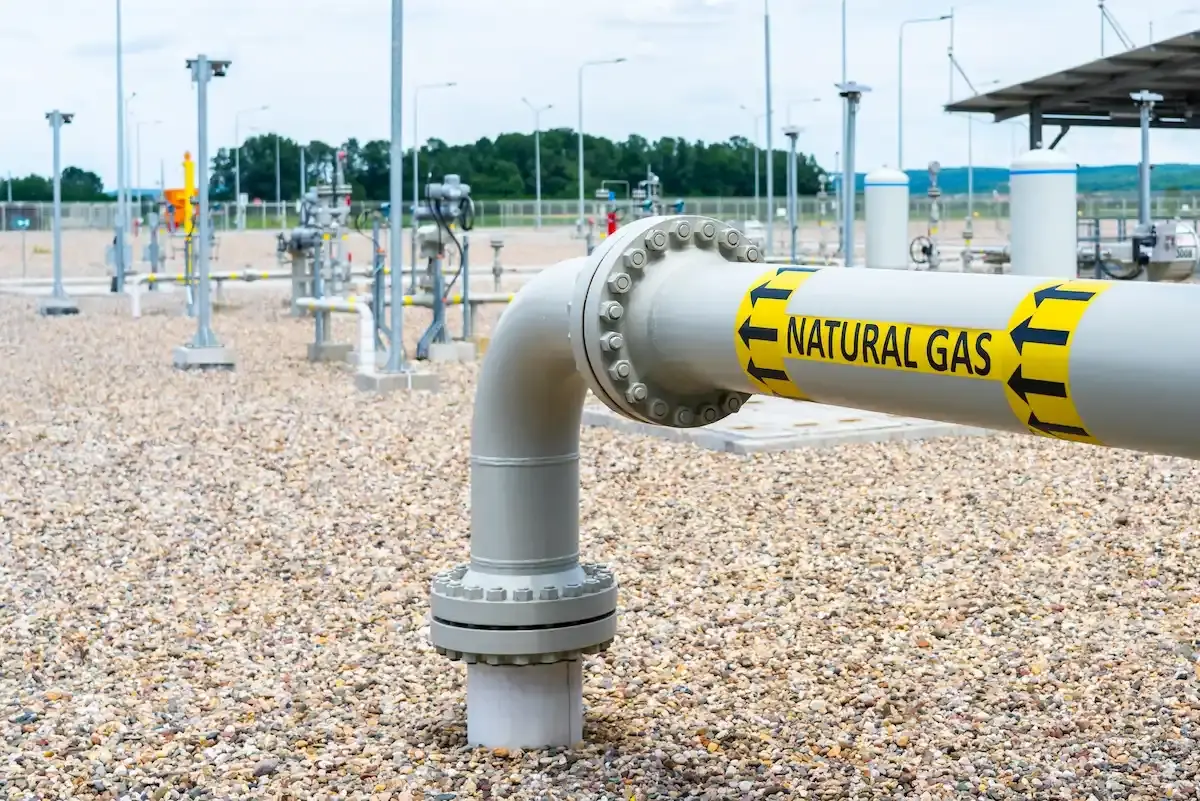
Strategic Resource Volume, Geological Distribution, and Monetization Infrastructure
Nigeria holds an officially audited proven natural gas reserve base of 215.19 trillion cubic feet, cementing the country’s standing as the largest hydrocarbon gas repository in Africa and the ninth largest globally.
This statutory volume gives the country a reserve life index exceeding 85 years at prevailing extraction rates.
According to regulatory audits declared by the Nigerian Upstream Petroleum Regulatory Commission under Chapter 1, Part III of the Petroleum Industry Act of 2021, the nation’s resource balance has decisively shifted toward dedicated gas exploration.
Non-associated gas accounts for 114.98 trillion cubic feet, while associated gas locked within crude oil reservoirs makes up 100.21 trillion cubic feet.
An estimated 55 trillion cubic feet—roughly a quarter of the audited national endowment—remains uncommitted to any commercial monetization project or export supply contract, presenting the primary frontier for domestic industrialization and foreign direct investment.
| Reserve Category / Metric | Audited Volume / Status | Primary Regulatory Source |
|---|---|---|
| Total Proven Gas Reserves (2P) | 215.19 Trillion Cubic Feet (TCF) | NUPRC National Petroleum Reserves Position |
| Non-Associated Gas (NAG) | 114.98 TCF (53.4%) | Upstream Subsurface Reservoir Audits |
| Associated Gas (AG) | 100.21 TCF (46.6%) | Field Production & Separation Accounting |
| Uncommitted Commercial Gas | ~55.00 TCF | National Gas Development Roadmap |
| African Continental Ranking | 1st Position | NUPRC / OPEC Hydrocarbon Bulletins |
| Global Reserve Ranking | 9th Position | International Energy Agency & Statistical Reviews |
| National Daily Production | 7.6 to 8.0 Billion SCF/D | Decade of Gas Operational Reports |
| Reserves Life Index (RLI) | 85.0 Years | NUPRC Upstream Field Performance Assessment |
Geological Architecture Across the Niger Delta and Frontier Basins
Commercial natural gas accumulations in Nigeria are concentrated within the Niger Delta basin, one of the world’s most prolific deltaic depocentres.
The petroleum geology is defined by the tertiary Akata-Agbada formational sequence, where paralic Agbada sandstone units serve as high-permeability reservoir rocks capped by marine Akata shales.
Onshore and shallow-water concessions contain substantial associated gas caps positioned above volatile crude reservoirs, historically subject to flaring before regulatory prohibitions were enacted.
The geological focus has shifted steadily toward deep offshore blocks.
In water depths ranging from 1,000 to over 3,000 metres, exploration drilling has unlocked massive non-associated gas fields trapped in structural roll-over anticlines, deep-sea turbidite fan channels, and fault-block traps.
These deepwater deposits yield low-impurity, dry sweet natural gas, requiring minimal preliminary processing before liquefaction.
Beyond the coastal core of the Niger Delta, inland depocentres hold significant contingent and prospective gas potential.
The Anambra Basin hosts verified commercial gas reservoirs, particularly within the Nkporo shale and Enugu formations, which already supply local industrial clusters and regional thermal stations.
The Cretaceous Benue Trough, the Bida Basin, the Dahomey Embayment, and the Nigerian sector of the Chad Basin remain exploratory targets where 2D and 3D seismic acquisition campaigns are being funded through the statutory Frontier Exploration Fund to identify standalone gas accumulations outside the volatile Delta region.
The Regulatory Framework: Petroleum Industry Act of 2021
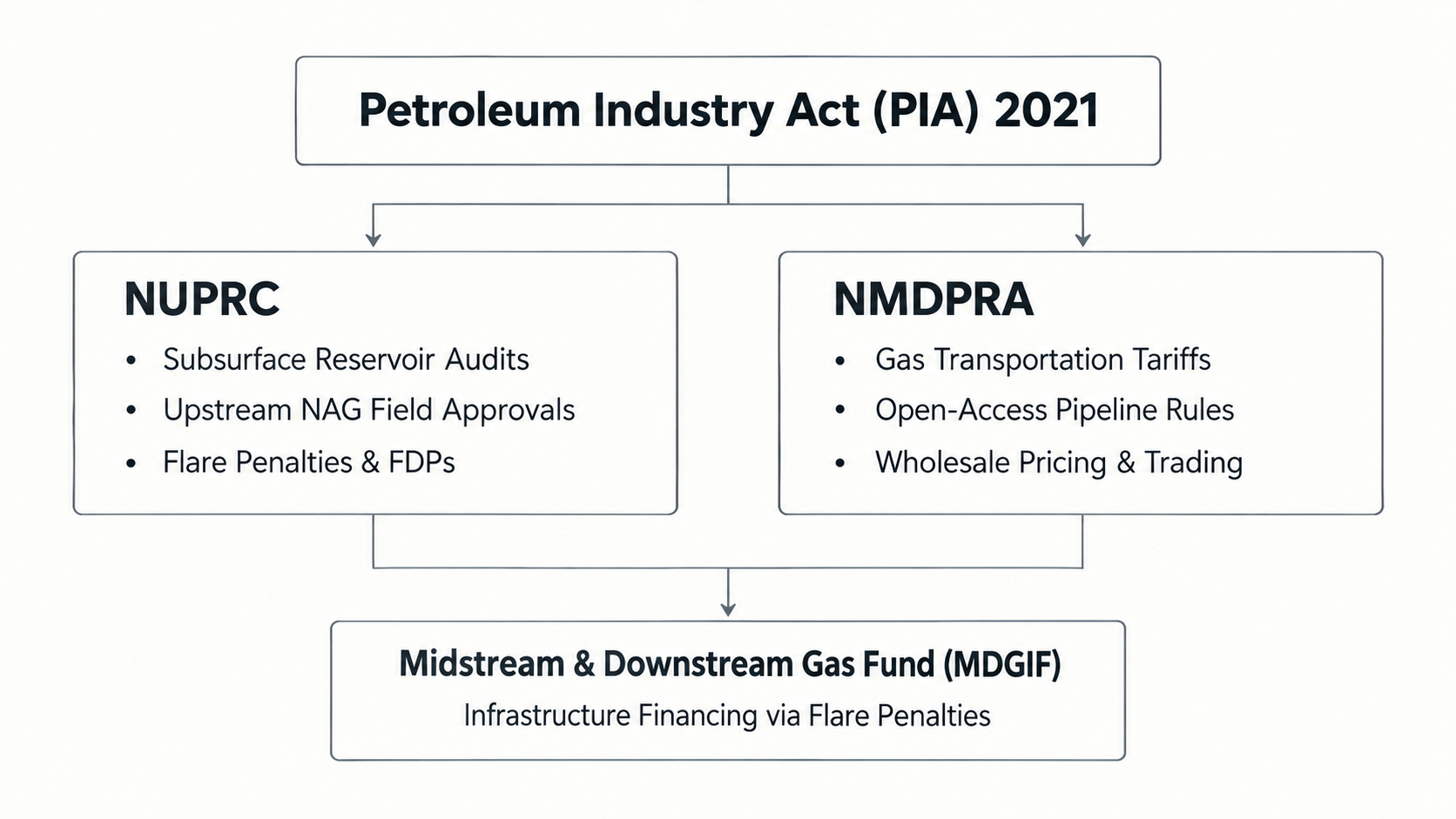
The operational, technical, and commercial administration of Nigeria’s gas resources is anchored on the Petroleum Industry Act of 2021, which dismantled the old, opaque, single-regulator model.
The statute bifurcated the regulatory structure into two technical entities: the Nigerian Upstream Petroleum Regulatory Commission, led by the Commission Chief Executive, and the Nigerian Midstream and Downstream Petroleum Regulatory Authority.
The NUPRC oversees geological acreage, exploration licenses, subsurface data, field development plans, and upstream extraction quotas.
The NMDPRA exercises exclusive jurisdiction over midstream transportation networks, open-access pipeline regulations, processing plant licensing, wholesale gas supply pricing, and end-user retail tariffs.
The PIA established dedicated fiscal regimes explicitly designed to encourage non-associated gas field development.
To overcome decades of capital concentration in crude oil, the Act lowered base royalties on gas production to between 2.5 and 5.0 percent, determined by reservoir water depth and field location.
Profits derived from dedicated gas production are exempt from the Hydrocarbon Tax, remaining subject only to the standard Companies Income Tax.
Operators are granted accelerated capital allowance deductions on production machinery, gas compression units, and gathering manifolds.
A central statutory mechanism is the Domestic Gas Delivery Obligation, administered jointly by both commissions.
Under the DGDO framework, upstream concessionaires must allocate a mandatory portion of their total production to designated domestic priority sectors, primarily power generation, fertilizer manufacturing, and methanol synthesis, before export permits are approved.
The PIA escalated financial penalties on routine gas flaring.
Revenues generated from flare infractions are no longer treated as general fiscal revenue; they are credited directly to the Midstream and Downstream Gas Infrastructure Fund to provide equity financing for strategic processing facilities and distribution trunklines.
Production Economics and National Utilization Metrics
Nigeria’s daily gas output fluctuates between 7.6 and 8.0 billion standard cubic feet per day.
This volume is distributed across three primary commercial channels: export processing, field operations, and domestic consumption.
|
|
35% |
Export Markets (Bonny LNG Trains 1-6, Escravos Exports, Regional WAGP) |
29% |
Field Reinjection & Upstream Operations (Reservoir Pressure Maintenance) |
28% |
Domestic Commercial Market (Thermal Power, Fertilizer Plants, Industry) |
8% |
Operational Flaring, System Shrinkage, & Transmission Losses |
Export platforms consume approximately 35 percent of gross output, dominated by LNG shipments to Asian, European, and South American markets, followed by cross-border deliveries via the West African Gas Pipeline.
Field use accounts for roughly 29 percent of daily production.
Because many Niger Delta fields are mature, operators re-inject large volumes of associated gas back into subsurface reservoirs to maintain crude reservoir pressure, drive artificial gas-lift routines, and fuel on-site turbine operations.
The domestic market takes 28 percent of daily output.
Thermal electricity generation stations consume the bulk of this domestic volume, followed by petrochemical plants, rolling mills, and commercial compressed natural gas facilities.
Operational flaring, transmission line shrinkage, and metering imbalances account for the remaining 8 percent.
The National Gas Expansion Programme and the national transition to compressed natural gas for transport are systematically absorbing this volume to cut import expenditures on refined liquid petroleum fuels.
Strategic Export Infrastructure and Regional Pipeline Networks
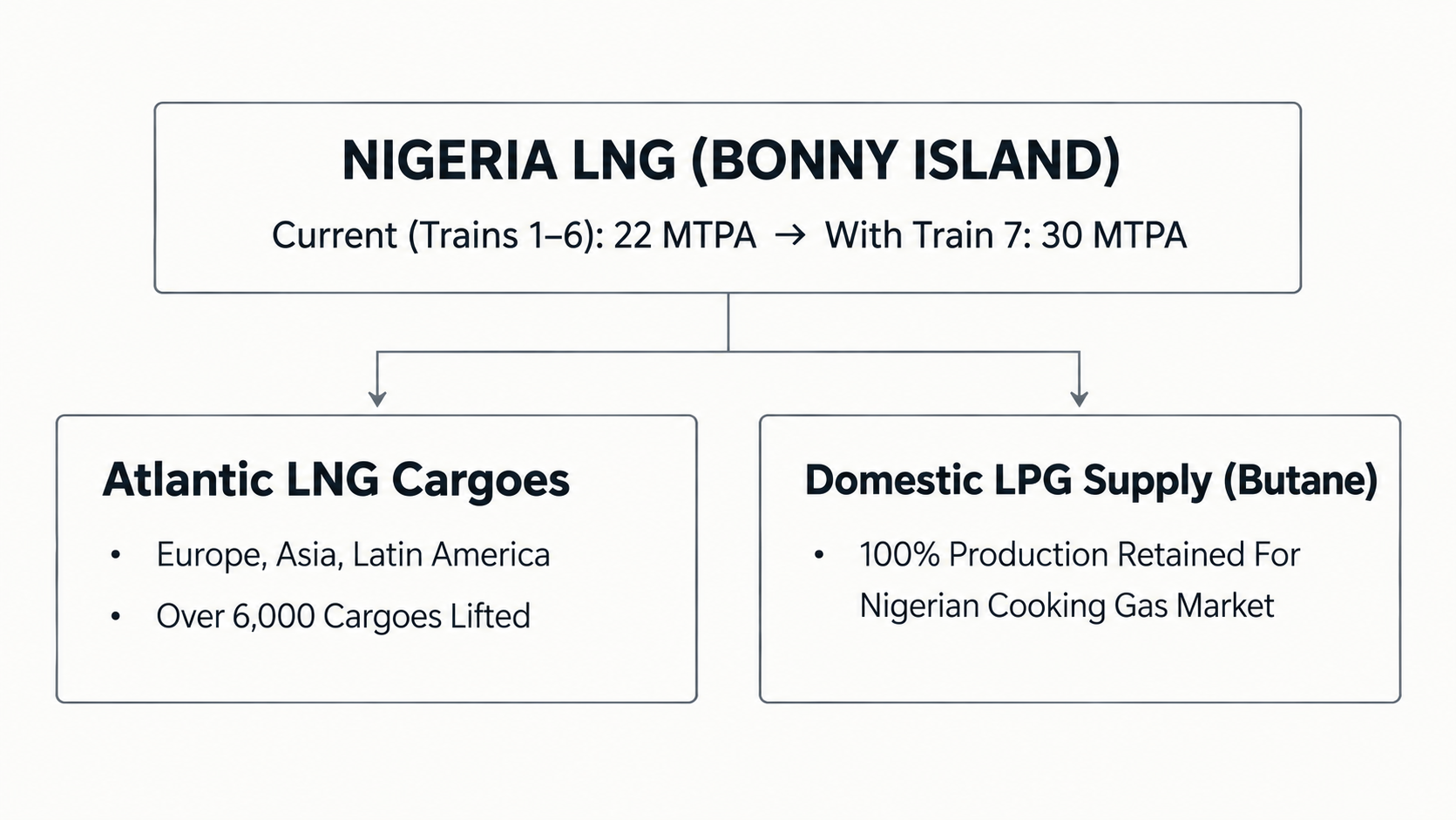
The centerpiece of Nigeria’s international gas monetization remains the Nigeria LNG complex located on Bonny Island, Rivers State.
Operating as an incorporated joint venture between the Nigerian National Petroleum Company Limited, Shell Gas, TotalEnergies, and Eni, the facility operates six processing trains with a collective capacity of 22 million metric tonnes per annum of liquefied natural gas, alongside 5 million metric tonnes per annum of natural gas liquids and condensates.
The ongoing Train 7 expansion adds 8 million metric tonnes per annum of processing capacity, pushing the complex’s total output to 30 million metric tonnes per annum and cementing Nigeria’s role as a major Atlantic Basin LNG exporter.
For regional overland trade, the 678-kilometre West African Gas Pipeline delivers natural gas from the Niger Delta through an offshore terminal connection at Itoki, Ogun State, to Cotonou in Benin, Lomé in Togo, and Tema and Takoradi in Ghana.
The pipeline fuels thermal stations across West Africa under long-term take-or-pay sales contracts, operating as a commercial model for regional economic integration.
Domestically, the 614-kilometre Ajaokuta-Kaduna-Kano pipeline serves as the primary transmission spine designed to move gas from southern extraction hubs through central Nigeria into northern industrial zones.
With a transport capacity of 2.2 billion standard cubic feet per day, the AKK pipeline connects to the existing Escravos-Lagos Pipeline System and the Obiafu-Obrikon-Oben gas interconnector, linking eastern and western supply corridors.
Long-range projects include the transcontinental Nigeria-Morocco Gas Pipeline, engineered to run offshore along the West African coast to Morocco and into Spain, and the Trans-Saharan Gas Pipeline, connecting Warri to Algeria’s export grid.
These multi-billion-dollar midstream corridors are designed to secure direct pipeline transit rights into the European Union energy market.
STRATEGIC GAS TRANSMISSION CORRIDORS
Escravos-Lagos Pipeline System (ELPS I & II) |
Commercial West Hub |
Obiafu-Obrikon-Oben (OB3 Interconnector) |
East-West Gas Bridge |
Ajaokuta-Kaduna-Kano (AKK Trunkline) |
North Industrial Spine |
West African Gas Pipeline (WAGP) |
Regional Sub-Sahara Hub |
Nigeria-Morocco / Trans-Saharan Lines |
EU Interconnectors |
Translating Nigeria’s 215 TCF reserve base into sustainable industrial growth requires resolving structural financial deficits within the domestic market.
The primary commercial obstacle remains liquidity illiquidity within the Nigerian Electricity Supply Industry.
Thermal power plants, which purchase over 70 percent of distributed domestic gas, frequently default on their contractual payments to gas producers due to poor end-user collection efficiency, unreflective retail tariffs, and distribution utility cash-flow deficits.
These upstream revenue shortfalls have accumulated into legacy debts exceeding several hundred million dollars, discouraging international oil companies from committing capital expenditure to non-associated gas wells.
Upstream portfolio realignment has also introduced operational transitions.
International majors, including Shell, ExxonMobil, and Eni, have concluded agreements to divest their onshore and shallow-water assets to indigenous operators, choosing to concentrate investments on deepwater offshore licenses and capital-intensive LNG export trains.
While this transition expands the footprint of Nigerian independent producers such as Seplat Energy, Oando, and First E&P, these domestic players must raise substantial syndicated debt to construct gathering manifolds, field compression plants, and processing units.
The upstream operating environment is adjusting to global decarbonization mandates and international carbon tariffs.
Securing development capital now requires operators to incorporate floating LNG technology, solar-powered field installations, and automated leak detection to minimize emissions profiles.
With more than 55 TCF of uncommitted gas still undeveloped in deep offshore reservoirs, Nigeria’s capacity to maintain its gas-first transition depends on regulatory stability, transparent open-access tariffs, and the financial health of off-takers across the domestic industrial value chain.


Lawyers Raise Alarm Over Rising Political Tensions Ahead Of 2027 Polls

Former El-Rufai Ally Joins APC, Vows To Mobilise Zazzau Support Base

Obasanjo’s Senate Ambition: PDP, APC Clash Over Eligibility Claims

Top 10 Stories From TheMatrix Newspapers, SUNDAY MORNING, SEPTEMBER 20, 2026
Top 10 Stories From TheMatrix Newspapers, SATURDAY MORNING, SEPTEMBER 19, 2026