Diplomatic Precedent, Cold War Clashes, and Global Shifts
The most consequential speeches delivered before the United Nations General Assembly reshaped multilateral treaties, fractured superpower alliances, and established binding international organizations directly from the rostrum.
While Article 10 of the Charter of the United Nations limits General Assembly resolutions to non-binding recommendations, the plenary hall remains the sole global arena where all 193 sovereign member states command equal voting rights.
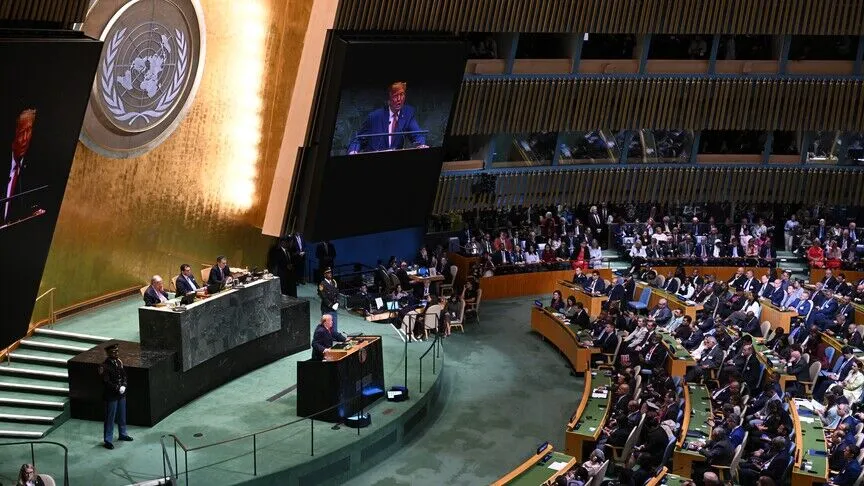
A single address delivered from behind the green marble dais can reset diplomatic relationships, shift international security postures, and alter global policy for generations.
Procedural Rules and the Expansion of Rostrum Speeches
The General Debate opens each annual session of the General Assembly in New York, gathering heads of state, heads of government, and ministerial delegations.
By unwritten diplomatic protocol dating to 1955, Brazil delivers the opening speech of the debate, followed immediately by the United States as the host country which was lead by President Donald Trump asking countries to leave the International Criminal Court.
The UN Department for General Assembly and Conference Management requests that leaders limit their delivery to 15 minutes, using a light system installed on the podium to signal time limits.
Because the Assembly operates on sovereign equality, the presiding officer will rarely cut the audio feed or interrupt a sitting head of state.
This absence of mechanical enforcement transforms the podium into an unrestricted stage, enabling delegates to challenge conventions, confront adversaries directly, and exceed their allocated speaking times.
| Year |
Speaker |
Member State or Entity |
Key Action or Proposal |
Lasting Diplomatic and Institutional Impact |
| 1953 |
Dwight D. Eisenhower |
United States of America |
“Atoms for Peace” civilian initiative |
Established the International Atomic Energy Agency (1957) |
| 1960 |
Fidel Castro |
Republic of Cuba |
4-hour, 29-minute anti-imperialist speech |
Set the verified record for the longest UNGA address |
| 1960 |
Nikita Khrushchev |
Union of Soviet Socialist Republics |
Desk pounding during decolonization debate |
Symbolized deep Cold War diplomatic fracture |
| 1963 |
Haile Selassie |
Empire of Ethiopia |
Universal human rights and racial equality address |
Adapted into international civil rights culture |
| 1964 |
Ernesto “Che” Guevara |
Republic of Cuba |
Rejection of Western hemispheric intervention |
East River mortar strike highlighted UN compound security |
| 1965 |
Pope Paul VI |
Holy See (Observer) |
First papal address (“War never again”) |
Codified the permanent moral and humanitarian observer role |
| 1974 |
Yasser Arafat |
Palestine Liberation Organization |
“Olive branch and freedom fighter’s gun” |
Adoption of UNGA Resolutions 3236 and 3237 |
| 2006 |
Hugo Chávez |
Bolivarian Republic of Venezuela |
Denunciation of United States unilateralism |
Illustrated digital media transmission of UN addresses |
| 2009 |
Muammar Gaddafi |
State of Libya |
96-minute challenge to Security Council veto |
Sparked global debate over permanent-member veto reform |
| 2012 |
Benjamin Netanyahu |
State of Israel |
Visual bomb diagram displaying enrichment levels |
Established modern visual prop usage in rostrum diplomacy |
Cold War Confrontations: Nuclear Treaties and Marathon Oratory
President Dwight D. Eisenhower altered global nuclear governance on December 8, 1953, with his address titled “Atoms for Peace.”
Eisenhower proposed that the United States and the Soviet Union divert atomic stockpiles into an international agency dedicated to agriculture, medicine, and electrical power generation.
The speech moved from diplomatic rhetoric into institutional reality, providing the foundation for the creation of the International Atomic Energy Agency in Vienna in 1957.
Seven years later, the 15th Session of the General Assembly in 1960 produced the most turbulent Cold War debates in the organization’s history.
On September 26, 1960, Cuban Premier Fidel Castro delivered an address lasting 4 hours and 29 minutes, which stands as the longest speech in UN history.
Castro utilized the marathon session to condemn American foreign policy and defend the newly established Cuban revolutionary government, institutionalizing the rostrum as a forum for developing nations to challenge dominant world powers.
During the same session, on October 12, 1960, Soviet Premier Nikita Khrushchev disrupted the 902nd plenary meeting during an exchange regarding Soviet authority over Eastern Europe.
While Philippine delegate Lorenzo Sumulong criticized Soviet policy, Khrushchev voiced his objections by taking off his shoe and brandishing it at his desk.
While contested historical accounts debate whether the shoe struck the furniture, the episode symbolized the sharp diplomatic friction dividing the Eastern and Western blocs at the height of the Cold War.
Decolonization, Racial Equality, and Non-State Recognition
The expansion of the United Nations during the 1960s transformed the General Assembly into an engine for decolonization and civil rights.
On October 4, 1963, Emperor Haile Selassie of Ethiopia mounted the rostrum to deliver an address demanding the elimination of racial prejudice and colonial rule across Africa.
Selassie warned that peace would remain unattainable until philosophies asserting racial supremacy were universally dismantled.
The speech resonated far beyond diplomatic channels, later providing the foundational text for Bob Marley’s 1976 human rights anthem “War.”
Security tensions crossed into physical space on December 11, 1964, when Argentine-Cuban revolutionary Ernesto “Che” Guevara addressed the plenary.
Guevara used his appearance to attack apartheid South Africa and criticize foreign military intervention across Latin America and Africa.
During the address, anti-Castro militants fired a 3.5-inch bazooka projectile from across the East River toward the Secretariat building, an impact that fell short in the water and led to a tightening of security perimeters around the Manhattan headquarters.
The parameters of United Nations protocol expanded further on November 13, 1974, when Palestine Liberation Organization Chairman Yasser Arafat addressed the Assembly.
Arafat became the first representative of an unrecognized, non-state entity to speak before the full plenary, stating he arrived carrying an olive branch alongside an armed movement.
The appearance triggered immediate institutional outcomes, leading the Assembly to adopt Resolution 3236 reaffirming self-determination rights, alongside Resolution 3237 granting the PLO permanent observer status.
Diplomatic engagement expanded through non-state religious authorities, initiated on October 4, 1965, when Pope Paul VI delivered the first papal address to the Assembly.
His declaration of “War never again” framed the moral and humanitarian responsibilities of the Assembly, setting a standard later continued by Popes John Paul II, Benedict XVI, and Francis under the Holy See’s permanent observer status.
Modern Polemics, Security Council Clashes, and Visual Statecraft
The post-Cold War era brought new forms of ideological confrontation to the General Assembly rostrum.
On September 20, 2006, Venezuelan President Hugo Chávez addressed the plenary following a speech by United States President George W. Bush, referring to the American leader as the devil and declaring that sulfur hung over the dais.
Chávez integrated literature into his critique, recommending Noam Chomsky’s foreign policy text “Hegemony or Survival,” an action that drove the book to international bestseller lists and demonstrated the commercial reach of UN speeches.
Systemic institutional friction surfaced on September 23, 2009, when Libyan leader Muammar Gaddafi delivered his inaugural address to the Assembly.
Speaking for roughly 96 minutes, Gaddafi tore the preamble pages of the United Nations Charter to protest the composition of the UN Security Council.
Gaddafi argued that the veto power wielded by the five permanent members—China, France, Russia, the United Kingdom, and the United States—violated the core premise of sovereign equality outlined in Article 2 of the Charter.
Visual statecraft reshaped modern General Assembly presentations on September 27, 2012, during an address by Israeli Prime Minister Benjamin Netanyahu.
Netanyahu displayed a diagram of an aerial bomb to chart stages of nuclear enrichment, physically drawing a red line across the paper to illustrate Israel’s strategic red lines.
The display bypassed traditional diplomatic speeches, establishing a visual presentation model tailored for immediate broadcast and digital distribution.
The Lasting Institutional Weight of General Assembly Addresses
The lasting significance of these addresses lies in the immediate concentration of global diplomatic attention inside a single room.
Unlike bilateral communiqués or regional summits, addresses delivered to the General Assembly are entered verbatim into the United Nations Official Document System and preserved by the Dag Hammarskjöld Library.
These archival records form primary source references that international tribunals, legal scholars, and foreign ministries study when assessing state practice and international intent.
The addresses that reshape international diplomacy combine specific political objectives with memorable language, delivered at moments when the international system is primed for institutional change.
From Eisenhower’s non-proliferation framework to Arafat’s accession to observer status, the speeches delivered from the green marble rostrum demonstrate that sovereign statements can alter global agreements, redefine international law, and shape the direction of world politics.