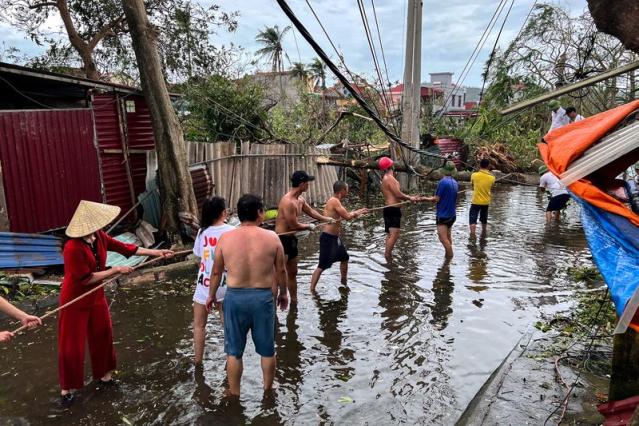
Since making landfall, the storm has devastated northern Vietnam, resulting in significant damage.
According to the Ministry of Agriculture and Rural Development, at least 44 people have lost their lives due to landslides and flash floods.
Among the deceased are a 68-year-old woman, a one-year-old boy, and a newborn baby. Over 240 individuals have been injured, and around 1.5 million people are still without power.
The typhoon has also caused extensive damage by tearing off roofs and uprooting trees.
Read Also: Japan Issues High Alert As Typhoon Shanshan Wreaks Havoc
Although the storm has weakened into a tropical depression, authorities are cautioning about potential further flooding and landslides as it continues to move westward.
In Yen Bai province, floodwaters reached one meter (three feet) high on Monday, prompting the evacuation of 2,400 families to higher ground.
Additionally, Yagi has caused the sinking and drifting of numerous fishing boats. On Sunday, search and rescue teams discovered 27 people drifting at sea after a dozen fishermen were reported missing.
Read Also: Typhoon Ampil Wreaks Havoc In Japan
Nearly 50,000 people have been evacuated from coastal towns, and authorities have advised residents to stay indoors. Schools have been temporarily closed in 12 northern provinces, including Hanoi.
Before impacting Vietnam, the storm—known as Yagi—had already claimed 24 lives across southern China and the Philippines.
Scientists attribute the increasing strength, frequency, and prolonged duration of such storms to climate change. Warmer ocean temperatures contribute to more intense storms by increasing wind speeds, while a warmer atmosphere holds more moisture, leading to heavier rainfall.