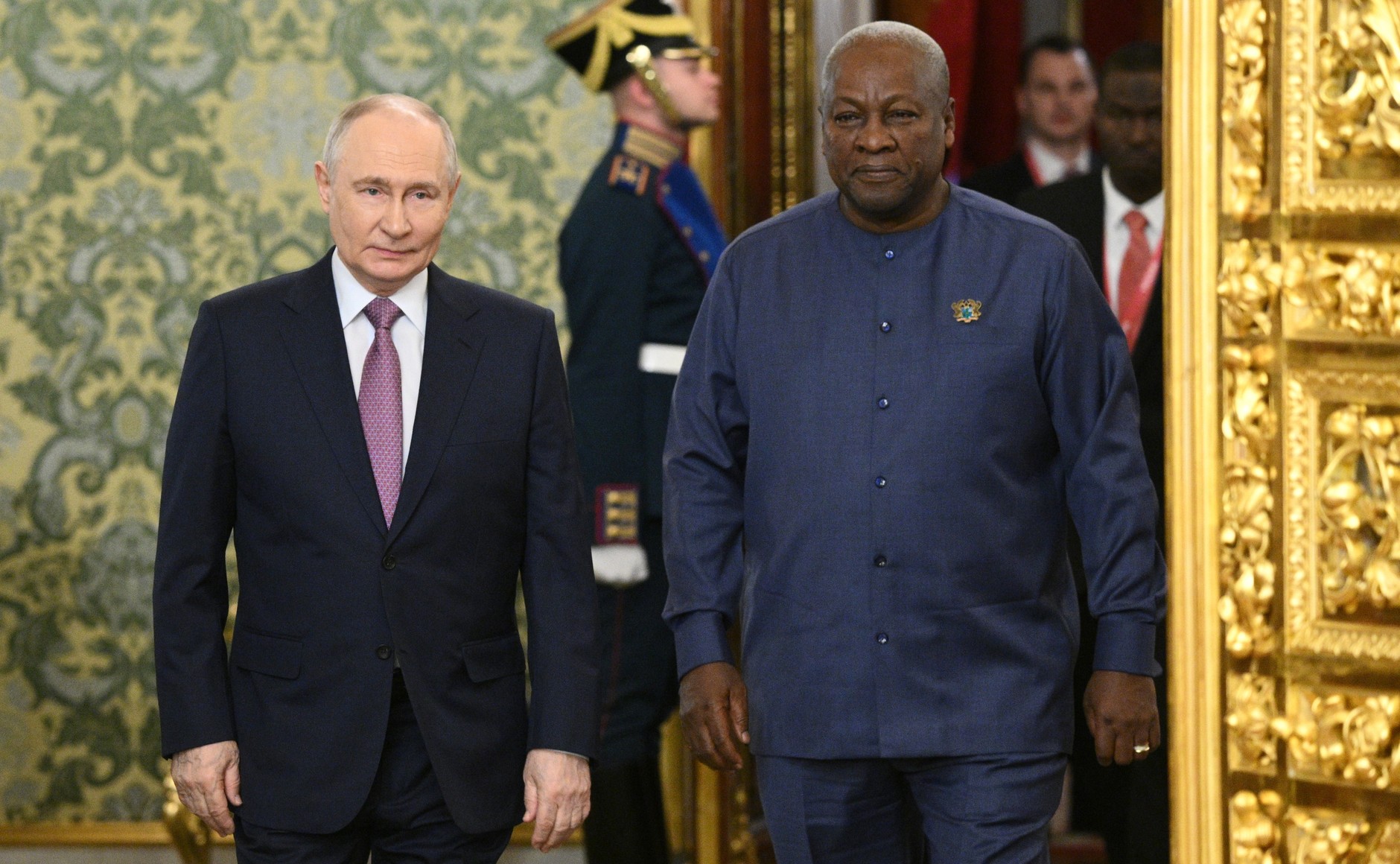
Russian President Vladimir Putin has agreed to stop the recruitment of Ghanaian nationals into his country’s military operations in Ukraine following mounting concerns over the deaths of at least 62 Ghanaians and the disappearance of 15 others in the prolonged conflict.
The agreement followed direct diplomatic talks between Putin and Ghanaian President John Dramani Mahama on the sidelines of the Russia-Africa Summit in Moscow, where the Ghanaian leader raised concerns about the growing number of his compatriots being drawn into the war.
Ghana’s Foreign Affairs Minister, Samuel Okudzeto Ablakwa, confirmed the development, describing it as an important outcome of the discussions between the two presidents.
Under the agreement announced by Accra, Russia will no longer permit Ghanaian citizens to participate in the conflict, whether through irregular recruitment networks or voluntary enlistment into its armed forces.
The decision comes amid increasing allegations that young Africans seeking employment and educational opportunities abroad have been deceived into travelling to Russia, only to find themselves recruited into military service and deployed to dangerous combat zones in Ukraine.
According to Ghanaian government figures, approximately 272 nationals have been recruited to fight for Russia since the war began in 2022, with at least 62 confirmed dead and 15 others still unaccounted for as of August 2026.
The casualty figures have heightened concerns in Ghana, where authorities have repeatedly demanded stronger action to prevent citizens from becoming involved in a conflict far from their homeland.
Announcing the outcome of the Moscow discussions, Ablakwa said Putin had accepted Ghana’s request to end the practice.
“Following concerns raised by President Mahama, President Putin has declared that Ghanaians are no longer allowed to participate in the war with Ukraine,” the minister stated.
He explained that the restriction would cover all forms of enlistment, including recruitment conducted through unofficial channels and applications from individuals who voluntarily sought to join Russian military operations.
The commitment followed earlier diplomatic engagements between Ghana and Russia, including discussions held in August between Ablakwa and Russian Foreign Minister Sergey Lavrov.
During those talks, Ghana expressed concern over reports that its citizens were being lured into military service through misleading promises of employment and financial rewards.
The Ghanaian government maintained that many of those recruited had travelled abroad in search of better opportunities rather than with the intention of participating in armed conflict.
The growing number of Ghanaian casualties has exposed the dangers associated with recruitment into foreign military operations.
In August, Ablakwa disclosed that 62 Ghanaians had died in the Russia-Ukraine war, while 15 others were missing.
The figures reflected an increase from earlier reports and intensified diplomatic pressure on Moscow to address the situation.
Reports of recruitment through misleading employment offers have also raised concerns about the vulnerability of young Africans seeking opportunities overseas.
Some individuals have reportedly been attracted by promises of lucrative jobs, educational opportunities or improved living conditions before being drawn into military contracts.
The circumstances surrounding individual cases vary, and not every African serving in the Russian military is known to have been recruited through deception.
Nevertheless, allegations of misleading recruitment practices have prompted calls for greater oversight and stronger protection for citizens travelling abroad.
Ghanaian authorities have maintained that their priority is to prevent further deaths and ensure that recruitment networks do not continue exploiting vulnerable jobseekers.
The latest agreement represents a diplomatic commitment, although details of its implementation and enforcement have yet to be publicly outlined.
It also remains unclear whether the arrangement will provide for the withdrawal or repatriation of Ghanaian nationals already serving in Russian military formations.
Ghana is not alone in expressing alarm over the recruitment of African nationals into the Ukraine conflict.
Governments across the continent, including Nigeria, Kenya, South Africa, Cameroon and The Gambia, have raised concerns about citizens allegedly being lured into the Russian military through promises of employment, education or financial incentives.
Kenyan authorities have pursued diplomatic interventions over the recruitment of their nationals, while South Africa has also sought the return of citizens reportedly drawn into the conflict under questionable circumstances.
Families in Cameroon have similarly demanded information about relatives believed to have travelled to Russia before becoming involved in military operations.
The issue has increasingly become a diplomatic concern for African governments, particularly as reports emerge of casualties, missing persons and individuals captured during fighting.
Ukrainian authorities recently reported that a citizen of Botswana who had allegedly been recruited through social media was killed in the Luhansk region.
The incident added to concerns about recruitment networks using online platforms to approach prospective recruits outside Russia.
Ukrainian officials have also reported that thousands of African nationals have entered Russian military service since the full-scale invasion of Ukraine began in February 2022.
While the figures and circumstances of recruitment require careful verification, the reports have intensified scrutiny of foreign enlistment practices.
For African governments, the challenge extends beyond preventing recruitment to identifying citizens already deployed, establishing their welfare and securing information about those killed, missing or captured.
Despite the dispute over military recruitment, Ghana and Russia used the Moscow summit to pursue wider bilateral cooperation.
According to Ghana’s Foreign Affairs Ministry, both countries agreed to strengthen collaboration in defence, energy, agriculture and education.
Among the major commitments announced was a proposed partnership to develop a 2,000-megawatt nuclear power plant in Ghana.
The project is intended to improve long-term electricity supply and support industrial development, although its financing, construction schedule and implementation arrangements have yet to be finalised.
The two governments also agreed on a new defence cooperation framework involving the acquisition of strategic military equipment for Ghana’s armed forces.
Additional discussions covered agricultural cooperation, fertiliser supplies and the expansion of scholarship opportunities for Ghanaian students.
These agreements reflect Accra’s effort to maintain diplomatic and economic relations with Moscow while addressing the risks faced by Ghanaian citizens involved in the Ukraine war.
However, the commitment to end recruitment stands out because of its immediate implications for the safety of Ghanaian nationals.
The agreement places renewed attention on how Russia intends to prevent Ghanaian citizens from entering its military service.
Questions remain over recruitment networks operating outside official channels, the identification of existing Ghanaian fighters and arrangements for citizens who may seek to leave military service.
For the Ghanaian government, the effectiveness of the agreement will depend on whether new enlistment is prevented and whether meaningful progress is made in obtaining information about those already affected.
The development could also encourage other African governments to pursue similar diplomatic commitments concerning their nationals.
Although Russia’s assurance applies specifically to Ghanaians, the wider controversy surrounding African recruitment into the conflict remains unresolved.