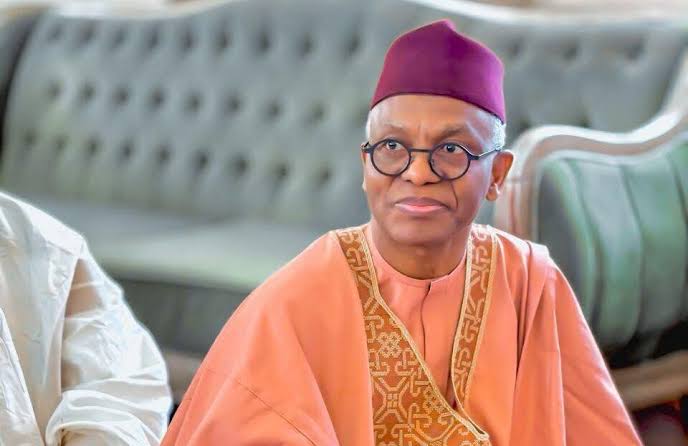
The legal battle between former Kaduna State Governor, Mallam Nasir El-Rufai, and the Department of State Services (DSS) took a significant turn on Monday as the Federal High Court in Abuja rejected his attempt to terminate his trial over the alleged unlawful interception of telephone conversations involving the National Security Adviser, Mallam Nuhu Ribadu.
In a ruling that cleared the way for the continuation of the criminal proceedings, Justice Joyce Abdulmalik dismissed El-Rufai’s no-case submission, holding that the prosecution had presented sufficient evidence to require the former governor to enter his defence.
The decision means El-Rufai must now confront the allegations contained in the five-count amended charge instituted against him by the DSS, rather than secure an early discharge at the close of the prosecution’s case.
The court consequently adjourned proceedings until November 25, 2026, for the defence to open its case.
However, the ruling does not amount to a conviction or a judicial finding that the former governor unlawfully intercepted Ribadu’s telephone conversations. It establishes only that the prosecution has presented a case requiring a response from the defendant.
The former governor has pleaded not guilty to the charges.
El-Rufai had approached the court with a no-case submission following the closure of the prosecution’s case, arguing that the evidence presented by the DSS was insufficient to justify continuing the trial.
His legal team, led by senior advocate Paul Erokoro, contended that the prosecution had failed to establish a prima facie case connecting him to the alleged offences.
The defence maintained that compelling El-Rufai to answer the charges without sufficient evidence would be unjustified and urged the court to discharge and acquit him.
A no-case submission is a legal procedure through which a defendant challenges the sufficiency of the prosecution’s evidence after it has concluded its case.
Where such an application succeeds, the defendant may be discharged without being required to present a defence.
However, Justice Abdulmalik disagreed with the defence’s position.
The judge held that the evidence presented by the prosecution was sufficient at that stage of the proceedings to warrant calling upon El-Rufai to answer the allegations.
The ruling effectively defeated the former governor’s attempt to end the case before presenting his own evidence.
The decision was also confirmed in separate reports by Channels Television and the News Agency of Nigeria.
The prosecution, represented by Oluwole Aladedoye, SAN, had opposed El-Rufai’s application, insisting that the oral and documentary evidence tendered before the court justified the continuation of the trial.
Aladedoye argued that the prosecution had established sufficient grounds for the defendant to respond to the allegations.
Central to the prosecution’s position was Exhibit B, which the DSS described as containing an alleged admission by El-Rufai concerning the interception of telephone communications involving the National Security Adviser.
The prosecution maintained that the defence had failed to adequately address the exhibit in its application.
Before closing its case, the DSS called two witnesses, including an operative of the agency and human rights lawyer Deji Adeyanju.
The court also viewed a recording of a television interview in which El-Rufai discussed telephone conversations allegedly intercepted from Ribadu.
During his testimony, Adeyanju reportedly acknowledged that he did not hear El-Rufai expressly state that he personally hacked the National Security Adviser’s telephone, although he testified about remarks concerning access to Ribadu’s conversations.
The distinction between allegedly obtaining access to intercepted conversations and personally carrying out unlawful interception remains relevant to the issues before the court.
The controversy originated from statements El-Rufai made during an appearance on Prime Time, an ARISE Television programme, on February 13, 2026.
During the interview, the former Kaduna governor alleged that Ribadu’s telephone conversation had been intercepted, enabling him to become aware of an alleged instruction to security operatives concerning his arrest.
El-Rufai stated that “someone wiretapped” the National Security Adviser’s telephone.
The disclosure attracted attention because it raised questions about how a conversation involving one of Nigeria’s senior national security officials could allegedly have been accessed by unauthorised persons.
The DSS subsequently instituted criminal proceedings against the former governor, alleging violations relating to the unlawful interception of telephone communications and national security.
The agency later amended the charge to five counts.
El-Rufai challenged the prosecution’s case after the DSS concluded its presentation of evidence.
The dispute has consequently moved from the circumstances surrounding the televised remarks to whether the evidence presented in court is sufficient to establish the alleged offences.
Monday’s ruling represents an important procedural development in the case, particularly because it requires the former governor to decide how to respond to the prosecution’s evidence.
At the defence stage, El-Rufai’s lawyers will have the opportunity to challenge the allegations further, present evidence and call witnesses where appropriate.
The prosecution, however, retains the legal burden of proving the criminal allegations beyond reasonable doubt.
The rejection of a no-case submission does not remove the defendant’s constitutional presumption of innocence.
The proceedings have also drawn attention to the wider questions surrounding the confidentiality of telephone communications, the handling of sensitive national security information and the legal consequences of alleged unauthorised interception.
Under Nigerian law, the unlawful interception of communications may constitute a criminal offence, depending on the circumstances and the applicable statutory provisions.
However, determining whether an offence occurred, who may have been responsible and whether the prosecution has proved the specific allegations against El-Rufai remains the responsibility of the trial court.
With the no-case submission dismissed, attention now turns to the November 25 hearing, when the former governor is expected to begin his defence.
The proceedings will provide an opportunity for his legal team to address the evidence presented by the DSS and advance its response to the allegations.
For the prosecution, the ruling allows the case to proceed beyond the preliminary challenge to the sufficiency of its evidence.
For El-Rufai, it marks the continuation of a legal contest in which his criminal liability has yet to be determined.
As the case returns to court next month, the central question will no longer be whether the prosecution has presented enough evidence to warrant a defence, but whether the allegations can ultimately be proved to the standard required by law. Until that determination is made, El-Rufai remains entitled to the presumption of innocence, notwithstanding Monday’s ruling against his no-case submission.