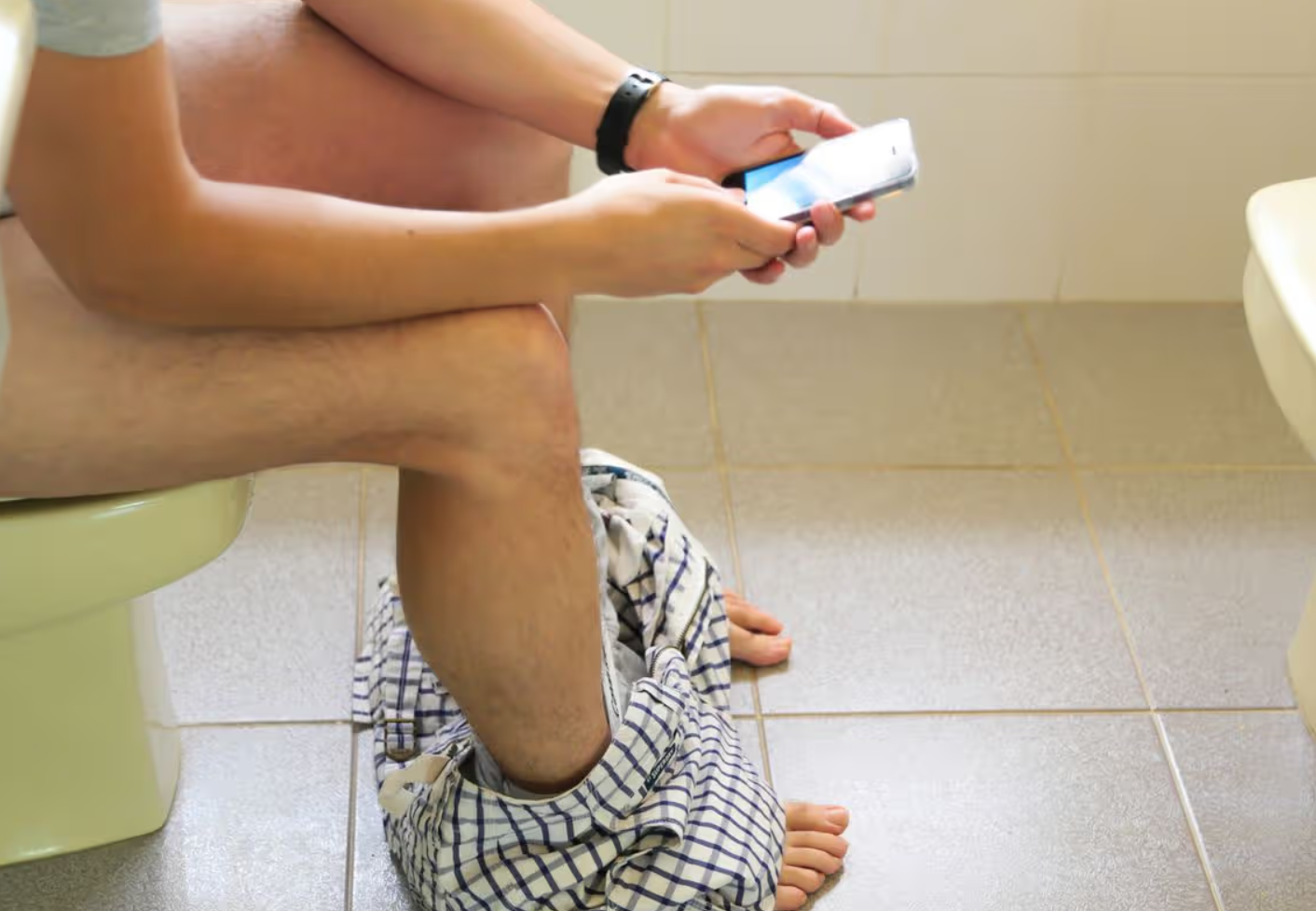
Be honest. It’s coming with you, isn’t it.
The toilet stopped being a place we go alone years ago. Somewhere between the arrival of the smartphone and the death of boredom, the bathroom became just another room we scroll in. A quick trip turns into six minutes of messages, headlines and half-watched videos.
It feels like nothing. And mostly it is nothing. But there’s a wrinkle worth knowing about, because you’re carrying a device that touches your face, your desk and your dinner table into a room built entirely around human waste, then carrying it straight back out.
The toilet visit isn’t the problem. What can hitch a ride is.
The awkward bit: we clean our hands, not our phones
Handwashing after the loo is drilled into most of us by about age four. Phone cleaning is not. And that phone gets pressed against a cheek, dropped on a kitchen counter, handed to a toddler and set down next to a plate of food.
Researchers have actually measured this. A 2021 study in BMC Infectious Diseases found bacteria on the touchscreens and backs of smartphones belonging to hospital staff, and a later meta-analysis pooling 26 studies across Africa put contamination among healthcare workers’ phones at roughly 85%. In one of those studies, only about one in ten workers said they cleaned their phone regularly, even though most knew it was picking things up.
Those are clinical settings, not your bathroom at home. The numbers don’t transfer directly. But the pattern does: the phone is the thing that never gets washed.
How phones pick up germs in the bathroom
Bathrooms are wall-to-wall shared surfaces. Door handles, taps, flush buttons, the seat, the stall lock. Anywhere a lot of hands land, microbes accumulate.
Bring a phone in and it quietly joins the list.
The trouble is the order of operations. You finish, you reach for your phone, and only then do you head to the sink. Whatever was on your hands is now on the screen, the case and the buttons.
Then you wash properly, exactly as you’re meant to. The phone doesn’t. It sits there, soapless.
So when your clean hands pick it up again, some of what you just washed off can come right back. And off it travels, to the next door handle, the next crisp packet, the next handshake.
Washing your hands is essential. It’s also only half the sequence. What you touch in the next four seconds matters, and almost nothing gets more hand time than a phone.
Your phone doesn’t stay put
A modern phone isn’t really a phone. It’s a wallet, camera, newspaper, TV, diary and office in one slab of glass. Which is exactly why it never sits still.
A normal Tuesday: gripped on a packed train, parked on a desk for six hours, carried into a bathroom after lunch, held in one hand while you eat with the other. Plenty of people take it to bed and grab it again before their eyes have properly opened.
Every one of those handoffs is a chance for microbes to move between your hands, the phone and whatever’s nearby.
None of which means touching your phone will make you ill. We live surrounded by microorganisms and the overwhelming majority are harmless or useful. Whether an exposure turns into an infection depends on the organism, the dose, the route into your body and how your immune system is doing that week. But since the phone shuttles constantly between grubby and clean, it’s worth a bit of the attention you already give your hands.
Cross contamination has a name for a reason
The loop above is called cross contamination: germs hopping from one person, surface or object to the next.
Phones aren’t special here. Keyboards, door handles, remote controls and shared card machines all do it. What makes phones stand out is intimacy. You hold one for hours. You tap it constantly. You bring it right up against your mouth, nose and eyes without thinking.
Good hygiene isn’t only about clean hands, then. It’s about noticing what those hands reach for next.
Public toilets are a different situation
Not every bathroom is the same.
Your bathroom at home, shared with two or three people, is nothing like a train station restroom that sees hundreds of strangers a day. More users means more hands on the same taps and handles, and more opportunity for contamination to build.
Hospitals and clinics are their own category entirely, which is why infection control there is taken so seriously.
Again, this doesn’t mean every phone that enters a public loo comes out coated in something grim. It means the number of possible routes goes up as the number of people goes up.
The fix is boring and obvious: if you don’t need the phone in there, leave it outside. One clean break in the chain.
When that isn’t realistic, the next best thing is simply not touching it between using the toilet and washing your hands. Keep it in a pocket or bag until your hands are clean and dry. That single habit closes off the most common route.
Does flushing really spread germs?
This is where the science gets genuinely vivid.
In 2022, engineers at the University of Colorado Boulder pointed high-powered lasers at a lidless commercial toilet and filmed what happens when you flush. The plume shot upward at over two metres per second and reached about 1.5 metres in under eight seconds. You can’t see it with the naked eye. It’s there.
Whether that matters much for a healthy person in a well ventilated bathroom is a separate question, and the honest answer is that it depends on the toilet, the airflow, the cleaning regime and which organisms are present. Nobody needs to lose sleep over it.
But it’s a decent argument for two small things. Close the lid before you flush if your toilet has one. And don’t park your phone on the cistern, the floor or the edge of the sink.
A bathroom is a poor home base for an object you handle all day and rarely wipe.
How often should you clean your phone?
There’s no universal schedule, and anyone who gives you one is guessing.
Someone who works from home and barely leaves the house has different needs from a nurse, a commuter or a teacher. Let your actual week set the pace.
Three ground rules, though.
Check the manufacturer’s guidance before you spray anything. Screens, oleophobic coatings and port seals vary, and the wrong chemical or too much liquid will kill a phone faster than any germ. Apple, Samsung and most other makers publish specific instructions.
Don’t ignore the case. A gleaming screen inside a filthy case doesn’t achieve much. If it comes off, clean it the way the maker recommends.
And treat all of this as a supplement. Wiping the phone is a bonus on top of proper handwashing, never a replacement for it.
The wider point
The phone-in-the-toilet question points at something larger. Personal tech has become close to inseparable from how we move through a day. People touch their phones hundreds of times without once clocking where their hands, or the phone, have just been.
For decades the advice has been to wash your hands before eating and after the loo. The phone era just adds a question to the end of that sentence: and then what do those clean hands pick up?
The answer isn’t to fear your phone or your bathroom, and you certainly don’t need to disinfect it after every tap. It’s a heavily handled object. Treat it like one.
The short version
- Leave the phone out of the toilet when you can. Easiest win available.
- If it comes with you, don’t touch it until you’ve washed and dried your hands.
- Keep it off bathroom floors, sinks and counters.
- Close the lid before flushing, if there is one.
- Clean the phone and case occasionally, using a method the manufacturer approves.
- Think about where it lands afterwards. A phone that’s been on the train, at the office and into a restroom shouldn’t go straight down next to your lunch.
Small habits. Stacked together, they break the routes germs use to move between people and things.
Bottom line
Taking a phone to the toilet is so automatic most of us don’t notice we’re doing it. That’s what makes it interesting. Handwashing works best when you also think about what your hands grab next.
A phone handled before you wash can hold onto microbes that transfer straight back to clean fingers. How much it matters depends enormously on where you are. The mechanism holds either way.
Leaving it outside is the simplest move. When that’s not on, keep your hands off it until they’re clean, wash properly, and wipe the device down now and then the way the maker recommends.
Your phone is probably the most useful thing you own. It’s also the most touched thing you own. Folding it into your everyday hygiene rather than treating it as a gadget that exists outside all this is a very small change with a decent return.
FAQ
Is it bad to take your phone to the toilet?
It isn’t dangerous by itself. The risk comes from touching the phone with unwashed hands and then picking it up again after washing, which can transfer microbes back to clean hands.
Do phones really carry bacteria?
Yes. Studies of healthcare workers’ phones have found bacterial contamination on the large majority of devices tested, most commonly staphylococci. Home and office phones are less studied but subject to the same handling.
What’s the safest way to clean a phone?
Follow the manufacturer’s instructions. Most recommend a soft, slightly damp lint-free cloth, and many now allow 70% isopropyl alcohol wipes on hard surfaces. Avoid pouring liquid onto the device or using abrasive cleaners.
Does closing the toilet lid before flushing help?
It reduces the aerosol plume released during a flush. A 2022 study filmed plumes rising about 1.5 metres from a lidless toilet within eight seconds.
Should I stop taking my phone to public toilets? It’s the simplest precaution, since public restrooms see far more users than a home bathroom. If you do take it in, keep it pocketed until your hands are washed and dried.