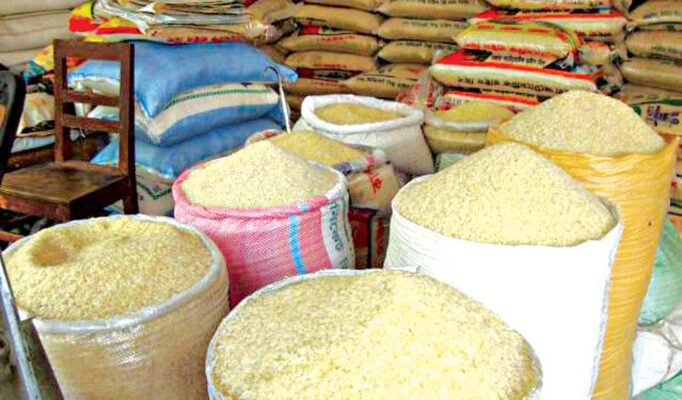
Mr. Shakin Agbayewa, the deputy chairman of the Lagos chapter of the All-Farmers Association of Nigeria (AFAN), has said that local price production can only supply 57% of the 6.5 million metric tonnes of rice used annually in the nation.
Along with the Chairman of the Rice Farmers Association of Nigeria (RIFAN) Lagos State branch, he made this comment in an interview with the News Agency of Nigeria.
They advised members not to repackage local rice in foreign bags in order to increase revenues during the interview.
Under the correct circumstances, the nation might meet its need for rice consumption, according to Mr. Agbayewa.
Furthermore, he decried the repackaging of local rice in foreign bags as “internal smuggling” stating it is partly responsible for the increase in rice prices
He stated, “We have a major problem in locally grown rice, we call it ‘internal smuggling’. A situation where local rice cultivators ‘rebag’ home-grown rice in foreign bags, to sell at a higher price. We lack honesty among local rice producers because of the rebagging of rice issues.
“In Nigeria today, we consume close to 6.5 to seven million metric tonnes of rice on a yearly basis. Unfortunately, our local production is about 57 per cent, thanks to the closure of the border by the past administration. We still have a shortfall of about 43 per cent.
“If we are honest, we can adequately meet the demands for local rice in the country. If all parameters are equal, local rice farmers will be able to meet the local demands for home-grown rice,”
On his part, the Lagos State RIFAN Chairman, Mr. Raphael Hunsa, called for concerted efforts to boost local rice production.
He emphasized that increasing rice production requires commitment and involvement from all stakeholders, especially youth.
Hunsa noted that the Lagos State rice mill at Imota, capable of producing 33,000 metric tonnes per hour, lacks enough paddy to operate.
He urged the government to support local farmers, reduce reliance on northern states for paddy, and attract more rice farmers to meet the growing demand for locally grown rice.