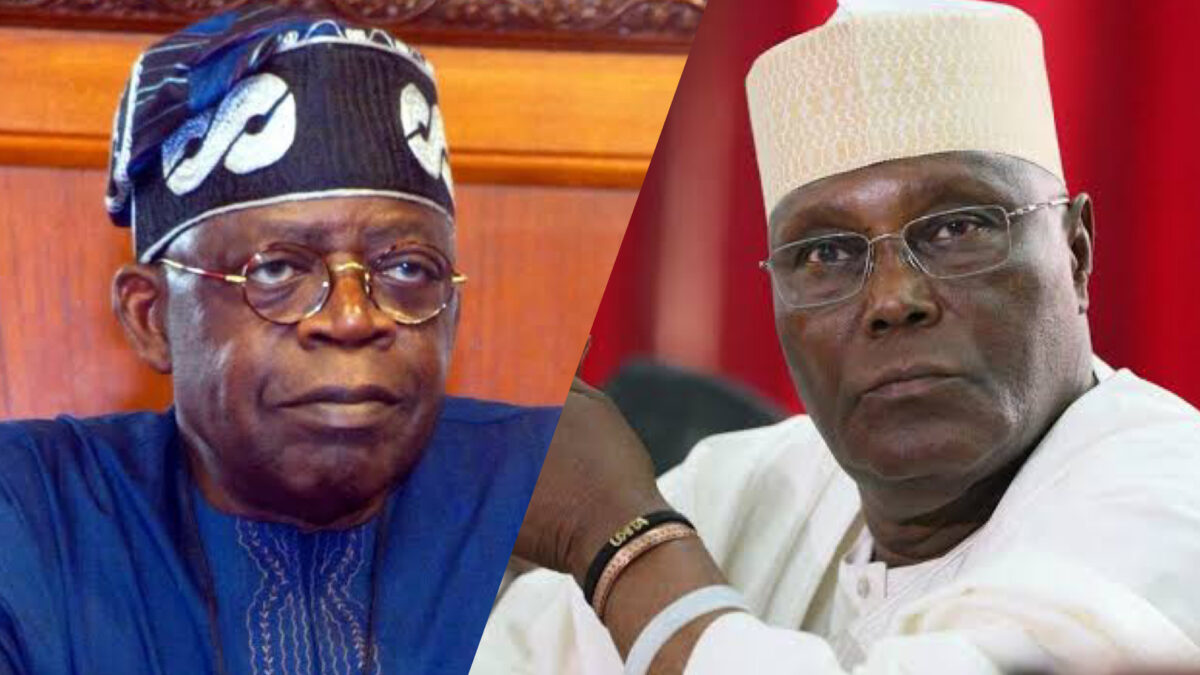
- FG’s Reforms, N4trn Bond Are ‘Paperwork That Cannot Light A Single Room’-Atiku
- Power Sector Crisis Cannot Be Fixed Overnight’, Expect Tinubu’s Scorecard Soon- APC
A fresh political war has erupted between the African Democratic Congress (ADC) and the All Progressives Congress (APC) over President Bola Tinubu’s unfulfilled electricity campaign promise, with former Vice President Atiku Abubakar accusing the administration of offering Nigerians paperwork instead of reliable power.
Atiku, who challenged Tinubu to account for his pledge to provide steady electricity and end estimated billing, dismissed the Federal Government’s legislative reforms, multitrillion-naira bond programme and infrastructure projects as inadequate excuses for persistent power shortages.
But the APC Presidential Campaign Council fired back, insisting that Tinubu’s 2023 campaign promise must be considered in its full context, arguing that the President had made significant interventions to address structural problems inherited by his administration.
The exchange followed a statement by APC campaign spokesman, Dele Alake, who defended the administration’s electricity sector scorecard against criticisms that Tinubu had failed to fulfil his campaign commitment.
Atiku, in a statement issued by Phrank Shaibu, Director of Strategic Communication of the ADC Presidential Campaign Council, accused the ruling party of attempting to distract Nigerians with an elaborate account of policies and projects while households and businesses continued to grapple with unreliable electricity.
He argued that after three and a half years in office, the administration had yet to deliver the steady electricity supply promised during the 2023 presidential campaign.
According to him, Nigerians continue to spend scarce resources on generators and other alternative energy sources, while paying electricity bills for services they cannot depend on.
Atiku particularly questioned the electricity band system, under which consumers are classified into Bands A, B, C, D and E and charged different tariffs.
He noted that some Band A customers pay about N209.50 per unit before Value Added Tax (VAT), yet the burden of unreliable supply cuts across all categories.
“Across every band, the same hardship endures: the power fails, but the bill arrives,” Atiku declared.
He also demanded clarification from the Federal Government over its plan to end electricity subsidies from 2027, despite assurances that there would be no immediate increase in tariffs.
The former Vice President questioned what would happen to consumers’ electricity bills when the subsidy regime eventually ends, warning that households already struggling with the cost of living should not be subjected to additional energy costs.
He promised that an ADC government would work with state governments and regulators to abolish the existing band system and introduce what he described as a fair, transparent and affordable electricity pricing framework.
Atiku further accused the Tinubu administration of failing to establish new electricity generation infrastructure of its own, arguing that its N4 trillion bond programme to settle outstanding debts owed to generation and gas companies had not translated into reliable power supply.
“Paying old debts is not the same as building new power infrastructure. Bonds cannot be presented as a substitute for power in people’s homes,” he said.
He also raised concerns over VAT on electricity and the proposed five per cent surcharge on certain fossil fuels, including petrol and diesel, under the Nigeria Tax Act, insisting that Nigerians deserved clarity on the government’s intentions.
Atiku’s criticism centred largely on Tinubu’s campaign declaration that Nigerians should not re-elect him if he failed to provide constant electricity within four years.
The former Vice President maintained that Nigerians had already lived through the period covered by the promise and should judge the President by his performance rather than explanations from his campaign officials.
“Dele Alake’s statement cannot light a home. Signing a law is not electricity. Raising a bond is not electricity. Approving a project is not power delivered,” he declared.
However, the APC Presidential Campaign Council rejected what it described as an incomplete interpretation of Tinubu’s campaign pledge, arguing that the President had explicitly qualified his commitment by promising to provide adequate reasons if he fell short of delivering.
Quoting Tinubu’s remarks at a meeting with members of the Organised Private Sector in Lagos ahead of the 2023 elections, Alake said the President had promised to tackle estimated billing and the structural challenges confronting the electricity industry.
Tinubu had declared: “Whichever way, by all means necessary, you will have electricity, and you will not pay for estimated bills anymore. A promise made will be a promise kept.”
However, he added that if he failed to fulfil the promise and sought a second term, Nigerians should not vote for him unless he provided adequate reasons for the shortfall.
Alake argued that critics had deliberately omitted the concluding qualification in the President’s statement, insisting that a fair assessment must consider both the original pledge and the administration’s record since assuming office in 2023.
Defending the government’s performance, the APC spokesman said Tinubu signed the Electricity Act, 2023, on June 9, barely two weeks after taking office, effectively opening up the power sector to greater participation by state governments.
He identified Lagos, Enugu, Abia, Ekiti, Oyo, Kaduna and Niger as states that had begun taking advantage of the legislation by establishing their own electricity regulatory agencies and attracting private investment.
The APC also defended the administration’s decision to address more than N6 trillion in accumulated legacy debts covering the period between 2015 and 2025.
According to Alake, the government introduced a Presidential Metering Initiative to close the country’s estimated seven million metering gap, adding that more than 1.5 million electricity customers had been metered in the last three years.
He said the administration had also aligned electricity tariffs more closely with the cost of supply to improve liquidity in the electricity market, while putting measures in place to protect low-income households.
On infrastructure, Alake disclosed that the Rural Electrification Agency had connected universities, hospitals and rural communities to solar power, while plans were underway to modernise the Osogbo Grid Control Centre, which he said was more than 60 years old.
He also cited the proposed construction of an East-West super grid as part of efforts to strengthen electricity transmission and expand the national grid.
Addressing concerns over the N4 trillion bond programme, Alake said its first and second tranches had raised more than N1.2 trillion to settle verified debts owed to 21 electricity generation companies and gas suppliers.
He argued that the intervention had reduced market risks and encouraged fresh investments by power companies, citing Geregu Power Plc’s recent investment in new transformers for its Geregu 1 Power Plant as evidence of improving confidence in the sector.
The APC spokesman further traced some of the administration’s ongoing infrastructure projects to the Presidential Power Initiative inherited from the previous administration of late President Muhammadu Buhari.
He said Tinubu reviewed the existing agreement with German partners and signed an acceleration agreement in December 2023 to speed up projects aimed at strengthening the transmission network.
According to him, the Federal Executive Council approved the first batch of five Transmission Company of Nigeria substations for upgrading in December 2024, with the projects expected to be completed and commissioned before the end of the administration’s first term.
He added that the council approved another batch of projects in June 2026 involving the construction of eight new substations and the upgrading of four existing facilities.
Alake maintained that power infrastructure projects required long-lead equipment and could not be completed overnight.
He also defended the introduction of different electricity service bands, describing the policy as a necessary step towards improving the financial sustainability of distribution companies, reducing government subsidy obligations and attracting investment.
While acknowledging that fixing the electricity sector remained unfinished business, he insisted that Tinubu had not abandoned his campaign commitment.
“As he seeks Nigerians’ mandate for a second term in office, he will proudly present his scorecard in the power sector and clearly tell Nigerians what remains to be done,” Alake said.
The latest confrontation has once again brought the Tinubu administration’s electricity pledge under intense political scrutiny, with the opposition demanding visible improvements in power supply while the ruling party points to legislative reforms, debt settlements, metering initiatives and transmission projects as evidence of progress.
At the heart of the dispute is a question that remains central to millions of Nigerian households and businesses: whether the government’s reforms and financial interventions will translate into dependable and affordable electricity before the next presidential election.