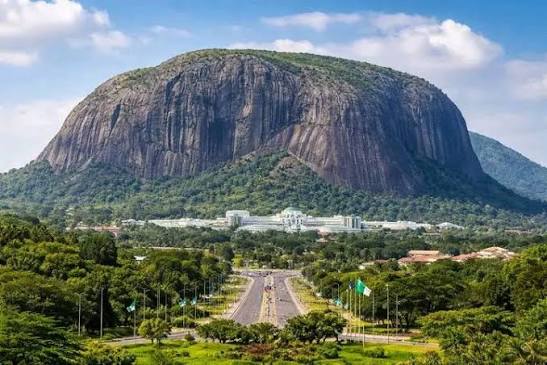
Aso Rock is not the residence of the Nigerian President, but a 400-metre-high granite monolith that anchors the administrative geography of Abuja and houses the nation’s principal democratic institutions at its foot.
Standing 936 metres above sea level, the rock dictates the spatial planning of Nigeria’s Three Arms Zone, serving as the backdrop to the State House, the National Assembly, and the Supreme Court.
Its rise from a regional geographic formation to the physical and metonymic core of Nigerian state authority stems from the 1976 recommendation to replace Lagos with an ethnically neutral, centrally positioned federal capital.
Geological Profile and Physical Topography of Aso Rock
Aso Rock is a massive granitic inselberg formed by deep volcanic intrusions that resisted millions of years of regional erosion across the central Nigerian Savannah.
The monolith rises approximately 400 meters above the surrounding urban plain, making it visible across major transport corridors linking the Federal Capital Territory.
Its physical prominence directly determined the orientation of the central government district, serving as the northern visual terminus of the monumental urban axis designed by international town planners.
Etymology: Linguistic Origin of the Word Aso
The name “Aso” originates from the language of the indigenous Gbagyi (Gwari) settlers who inhabited the plains surrounding the rock for centuries prior to federal land acquisition.
In the local dialect, the root word translates directly to “victory” or “triumph,” reflecting the rock’s historical function as a natural mountain fortress and defensive sanctuary during inter-tribal skirmishes.
The term later lent its name to the surrounding settlement of Asokoro, which modern development transformed into one of Abuja’s high-security diplomatic and administrative districts.
Colloquial usage subsequently merged the natural formation with the nearby presidential estate, leading to the popular shorthand of referring to executive decisions as coming directly from “Aso Rock.”
The Aguda Panel and the 1976 Exit from Lagos
By the early 1970s, Lagos suffered from acute infrastructural collapse, severe coastal traffic gridlock, and land constraints that prohibited the expansion of military and civilian federal ministries.
Lagos also sat within the ethnic territory of the Yoruba southwest, which challenged post-civil war objectives seeking a national capital that did not align with any of Nigeria’s dominant regional power blocs.
In 1975, the military administration led by General Murtala Mohammed appointed an eight-man panel chaired by Justice Akinola Aguda to identify a viable alternative territory.
The Aguda Panel presented its recommendations in 1976, advising the immediate establishment of an 8,000-square-kilometre neutral zone near the geographic centre of the country.
The regime promulgated Decree No. 6 of 1976, legally establishing the Federal Capital Territory and creating the Federal Capital Development Authority (FCDA) to direct municipal construction.
The Abuja Master Plan and the Three Arms Zone Architecture
The Federal Capital Development Authority commissioned International Planning Associates (IPA)—a consortium of architectural and planning firms—to design the Abuja Master Plan.
IPA planners structured the central area around a linear axis modelled partly on modern planned capitals like Brasília and Washington, D.C.
Aso Rock was deliberately positioned as the focal point of the Three Arms Zone, embedding the natural formation into the constitutional balance of power.
The State House (Executive), the National Assembly Complex (Legislative), and the Supreme Court Complex (Judiciary) were situated symmetrically around the formation, utilizing the rock as a natural acoustic and security buffer.
This configuration ensured that the three independent branches of government maintained physical proximity while operating within clearly demarcated functional zones.
Evolution of Aso Villa: From Aguda House to the Modern State House
The construction of the executive residential and operational infrastructure occurred across distinct phases spanning two decades.
During the second republic under President Shehu Shagari, the government built Akinola Aguda House to serve as a temporary Presidential Lodge and Guest House for visiting dignitaries.
Aguda House was officially named in 1983, functioning as the initial base of executive operations while site work on the primary residential sector lagged behind schedule.
Following the 1985 coup that brought General Ibrahim Babangida to power, construction on the permanent Presidential Villa accelerated under high-security contractual arrangements.
The primary complex was completed in 1991, featuring hardened executive offices, subterranean meeting suites, security perimeters, banquet facilities, and private living quarters for the Head of State.
On December 12, 1991, General Babangida formally relocated the administrative capital from Lagos to Abuja, becoming the first leader to occupy the newly completed Aso Villa.
Following the transition, Aguda House was reassigned as the official residence and working complex of the Vice President of the Federal Republic of Nigeria.
Structural and Political Distinctions: Aso Rock vs. Aso Villa
Journalistic and conversational references routinely treat the natural geological formation and the government compound as synonymous, creating technical inaccuracies in public reporting.
The physical complex consists of separate functional entities operating within a restricted security zone governed by the Brigade of Guards and the State Security Service.
| Architectural / Administrative Feature |
Statutory Function |
Historical Milestone |
| Aso Rock |
Natural granite inselberg and urban visual anchor |
Geological baseline, 400m elevation above plain |
| Aso Villa (State House) |
Official residence and working executive office of the President |
Completed in 1991; first occupied by Ibrahim Babangida |
| Akinola Aguda House |
Official residence of the Vice President (former interim lodge) |
Commissioned in 1983; hosted initial Abuja executive tasks |
| Three Arms Zone |
Constitutional precinct housing Executive, Legislature, Judiciary |
Conceptualised in 1979 Abuja Master Plan by IPA |
Contemporary Political Metonymy and National Significance
The physical proximity of Aso Rock to the levers of national power transformed the geological formation into a metonym for the presidency and the federal government.
When international diplomats and local media reference statements emerging from “Aso Rock,” the reference points exclusively to presidential policy directives rather than the natural monolith.
The inselberg remains strictly off-limits to routine tourism and public hiking due to its inclusion within the high-security surveillance perimeter surrounding the Presidential Complex.
The story of Aso Rock demonstrates how physical terrain was deliberately selected and incorporated into the design of a planned capital, linking a prehistoric granite formation to the governance of modern Nigeria.