The Nigerian National Petroleum Company (NNPC) Limited has showcased its growing capacity for methane emissions measurement, reporting and verification at the ongoing 31st Conference of the Parties to the United Nations Framework Convention on Climate Change (COP31) in Antalya, Türkiye.
The national oil company said it had advanced its methane emissions reporting from Level 1 to Level 3 under the Oil and Gas Methane Partnership (OGMP 2.0) framework, positioning it as a reference point for other energy producers and operators across Africa.
The development was disclosed by Chinedu Igwe, Managing Director of NNPC Foundation Ltd/Gte, while presenting the company’s progress at a high-level session convened by the Oil and Gas Decarbonisation Charter (OGDC).
The session, held at the World Green Economy Organization (WGEO) pavilion in the Blue Zone, focused on accelerating global methane mitigation in emerging economies and brought together representatives of international energy companies, financiers and climate institutions.
Igwe, who shared the panel with representatives of Petrobras and PETRONAS, said NNPC Limited had strengthened its emissions management framework through credible data collection, improved reporting systems and a change in operational culture.
He explained that the company’s progress demonstrated that national energy companies in emerging economies could establish credible systems for measuring, reporting and verifying methane emissions in line with international standards.
According to him, the company had also deployed the MiST reporting platform, developed by Carbon Limits, to facilitate independent feedback on its emissions data.
The company has equally conducted leak detection and repair (LDAR) exercises on one of its assets, bringing it close to Level 4 under the reporting framework.
“Reporting gives us a clear story to tell management and a practical tool for engaging our operators,” Igwe said.
He explained that the system enabled the company to track its carbon footprint, assess progress and identify areas requiring further intervention.
The panellists agreed that methane emissions could be reduced to near zero without undermining energy security, affordability and sustainability, stressing that emerging economies should not be forced to choose between economic development and environmental protection.
NNPC Builds Emissions Reporting Capacity In 18 Months
NNPC Limited’s contribution to the OGDC’s 2026 status report on emissions mitigation highlighted how the company developed the capacity to measure its carbon footprint through a credible reporting and verification system within 12 to 18 months.
The report, launched at COP31, reviews member companies’ interim emissions ambitions, methane and gas-flaring action plans, as well as progress in measurement and implementation.
NNPC Limited joined the OGDC at COP28 in Dubai, United Arab Emirates.
The charter, conceived by the Oil and Gas Climate Initiative (OGCI), provides a platform for oil and gas companies to collaborate, exchange technical expertise and develop credible approaches to reducing emissions.
NNPC Pushes Natural Gas As Africa’s Energy Transition Driver
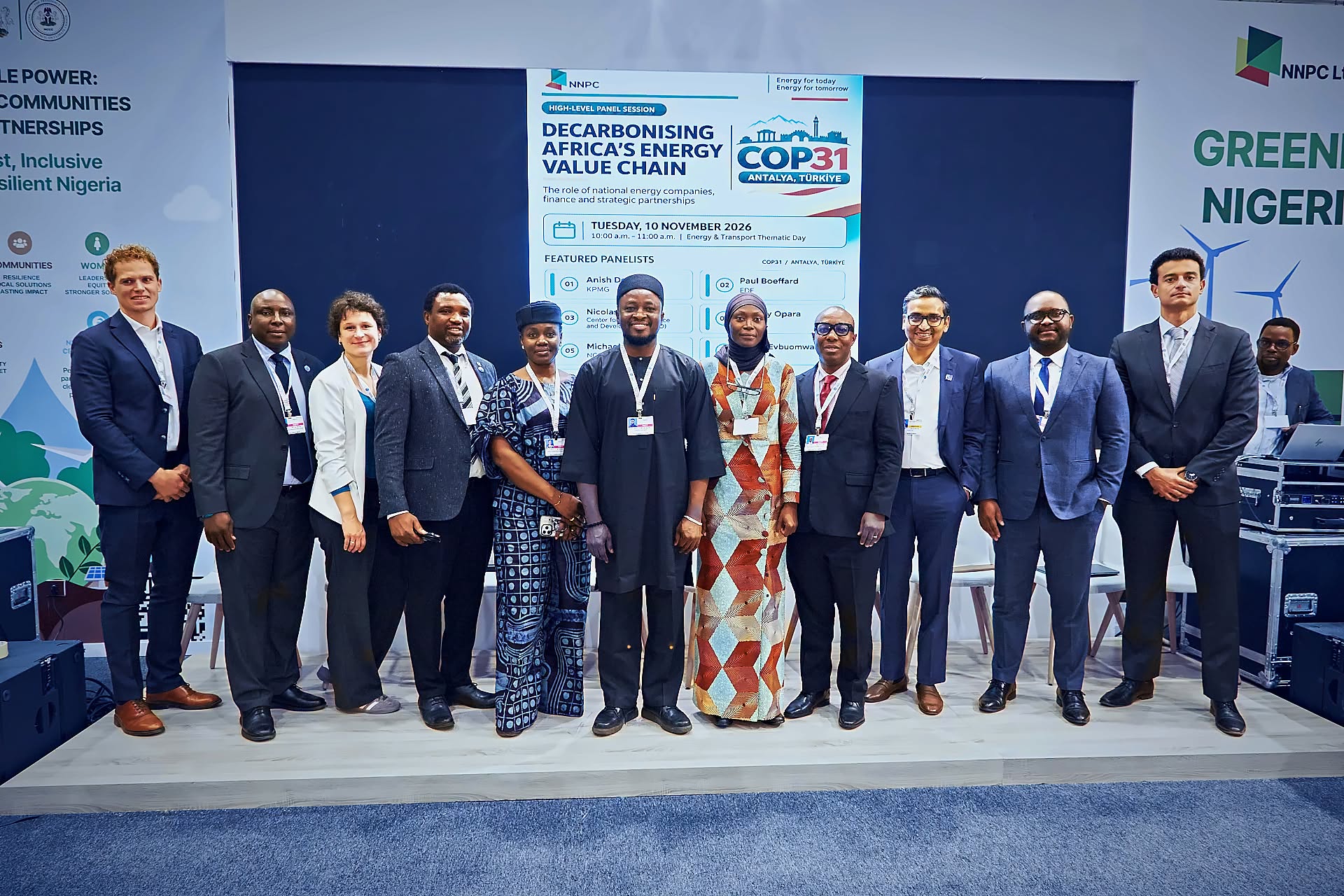
At the Nigerian Pavilion, NNPC Limited also led a high-level discussion on decarbonising Africa’s energy value chain, highlighting the role of national energy companies, financing and strategic partnerships.
During the session themed, “Decarbonising Africa’s Value Chain: The Role of National Energy Companies, Finance and Strategic Partnerships,” Philemon Yilleng, Manager, Sustainability Strategy, Standards and Policy at NNPC Limited, presented natural gas as a critical instrument in the company’s energy transition strategy.
Yilleng said the company was prioritising gas development while simultaneously strengthening its operations to reduce emissions.
He explained that NNPC Limited was pursuing investments in gas production and utilisation alongside renewable energy development, rather than treating the different components of the energy transition as separate or sequential projects.
According to him, the company is also working with regulators, joint venture partners and financiers to integrate sustainability into its operations.
Stephanie Saunier, Managing Director of Carbon Limits, who participated in the panel, commended NNPC Limited’s emissions measurement, reporting and verification framework, describing the availability of credible data as important to building investor confidence.
NNPC Explores Climate Financing Opportunities
On the sidelines of COP31, NNPC Limited also explored opportunities for project financing and development through a meeting involving representatives of the Inclusive Climate Action Fund (ICAF) and ANTAN Producing Limited.
The company’s delegation was led by Hauwa Mshelia, Chief Strategy and Sustainability Officer, while Haruna Abdurrahman, Managing Director of NNPC New Energy Limited, also participated.
The discussions focused on potential areas of collaboration in climate-related project development and financing.
NNPC Limited further participated in the Boston Consulting Group (BCG) Leaders Roundtable on delivering methane emissions reductions across the waste and energy sectors.
At the roundtable, Ikechukwu Aturuobi, Manager, Sustainability Partnerships at NNPC Limited, joined other industry leaders to examine practical strategies for reducing methane emissions across both sectors.
The company’s participation at COP31 is anchored on its sustainability theme, “Action Not Words,” with its net-zero pathway built around a verified emissions baseline.
NNPC Limited has set 2030 as the target year for eliminating routine gas flaring and reducing methane emissions.
By 2050, the company plans to deepen its transition towards low-carbon technologies through the electrification of operations, increased use of renewable energy and deployment of carbon capture and storage technologies.
The company’s latest disclosures at COP31 underscore its efforts to align Nigeria’s national energy industry with global emissions reduction commitments while maintaining energy security, expanding gas utilisation and attracting investment into the sector.