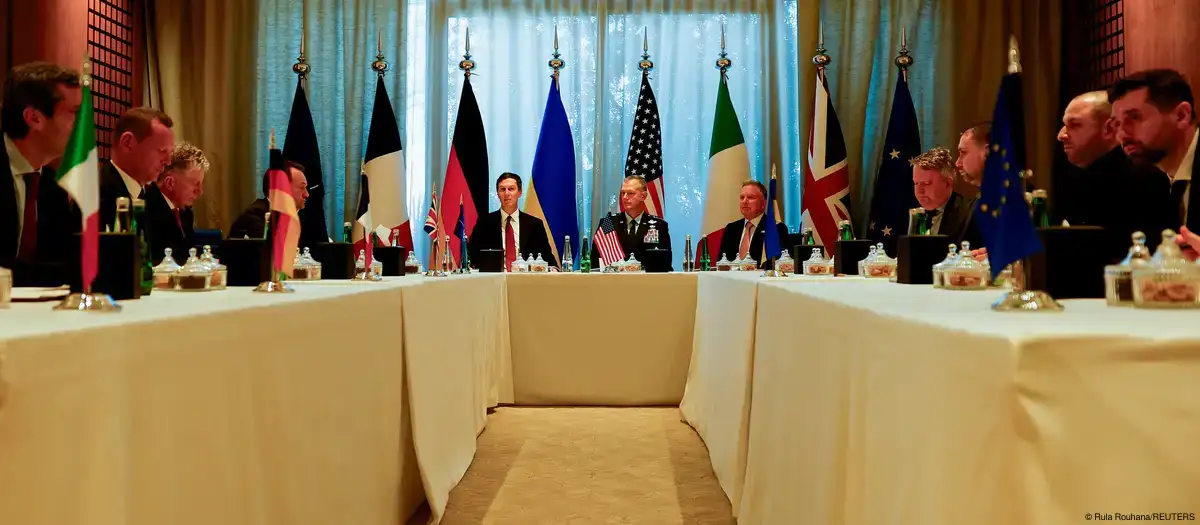
Representatives of the United States, Russia and Ukraine have begun a fresh round of trilateral peace talks in Abu Dhabi, United Arab Emirates, as President Donald Trump expressed optimism that an agreement to end the war could be reached soon.
The meeting, which began on Tuesday, is part of Washington’s renewed diplomatic efforts to end Russia’s full-scale invasion of Ukraine, which has continued for more than four years.
Trump’s special envoys, Steve Witkoff and his son-in-law, Jared Kushner, are leading the American delegation.
Speaking on Monday, the US president described the discussions as encouraging, saying both countries were tired of the prolonged conflict and the loss of military personnel.
“They talk about wars, Ukraine and Russia. And by the way, we’re having a very good conversation about that in Abu Dhabi,” Trump said.
“Ukraine and Russia are tired of fighting. They’re tired of seeing dead young soldiers,” he added.
Ukraine’s delegation is led by Rustem Umerov, head of the country’s Foreign Intelligence Service and its lead representative in previous rounds of negotiations. Other members include Kyrylo Budanov, head of President Volodymyr Zelenskyy’s office, and Davyd Arakhamia, parliamentary leader of Zelenskyy’s party.
The Russian delegation is headed by Kremlin aide Vladimir Medinsky, alongside other senior officials, including Deputy Foreign Minister Sergei Ryabkov and Yuri Ushakov, according to Kremlin spokesperson Dmitry Peskov.
The latest meeting follows an earlier US-brokered trilateral session in Geneva in February 2026. Previous negotiations have produced prisoner exchanges and temporary localised ceasefires but have failed to resolve major disagreements between Moscow and Kyiv.
Russian Foreign Minister Sergey Lavrov said security issues affecting Russia, Ukraine and the wider region would feature prominently in the discussions. He added that the parties would seek to agree on principles that could guide consultations towards a comprehensive settlement.
Umerov said Ukraine’s priorities included ending hostilities, obtaining reliable post-war security guarantees, rebuilding the country’s economy and addressing humanitarian concerns.
However, the two sides remain divided over the terms of a possible peace agreement.
Russia is demanding that Ukraine withdraw from Donetsk, Luhansk, Zaporizhzhia and Kherson, four regions Moscow claims to have annexed. The Kremlin also wants Kyiv to abandon its ambition of joining NATO and accept restrictions on the size and capabilities of its armed forces.
Zelenskyy has rejected demands to surrender territory not under Russian control, insisting that any settlement must include firm security guarantees from the United States and other NATO allies. He has also maintained that Ukraine must retain the right to determine the future size of its military and its security partnerships.
The negotiations come amid strained relations between Washington and Kyiv. Trump has repeatedly pressed Zelenskyy to consider concessions to Moscow, suspended direct US financial and military assistance to Ukraine and called on other NATO members to purchase American weapons for Kyiv.
In an interview with CBS News’ 60 Minutes programme on Sunday, Trump said he remained confident that the conflict could end soon, taking credit for the diplomatic efforts.
He also suggested that Ukraine could emerge from a peace agreement with altered borders, saying the country would have “a little bit different shape”.
A US official, speaking ahead of the Abu Dhabi meeting, said Washington was “cautiously optimistic” but acknowledged that the discussions were an opening for more difficult negotiations.
The official said both sides remained sceptical of each other’s intentions, although the US would continue working to identify areas of agreement.
Ukrainian lawmaker Oleksandr Merezhko, however, expressed little expectation of a major breakthrough, arguing that Russia’s demands remained unacceptable to Kyiv. He suggested that Moscow was using negotiations to avoid further pressure from Washington rather than pursuing a genuine settlement.
Meanwhile, Samuel Charap, a senior political scientist at RAND, said discussions about broader European security arrangements appeared to be a new element of the talks, but cautioned against expecting a major agreement after months without substantial negotiations.
Fighting has continued along the approximately 745-mile frontline, while both countries have expanded their long-range drone and missile attacks.
Ukraine’s air force said Russia launched 162 drones and one ballistic missile overnight into Tuesday. It reported that 135 drones were shot down or suppressed, with impacts recorded in 19 locations.
Russia’s Defence Ministry, meanwhile, said its forces intercepted at least 155 Ukrainian drones during the night.
The continuing attacks have added to civilian casualties and damage to infrastructure, particularly in Ukraine, as diplomatic efforts struggle to bridge the differences between the two countries.