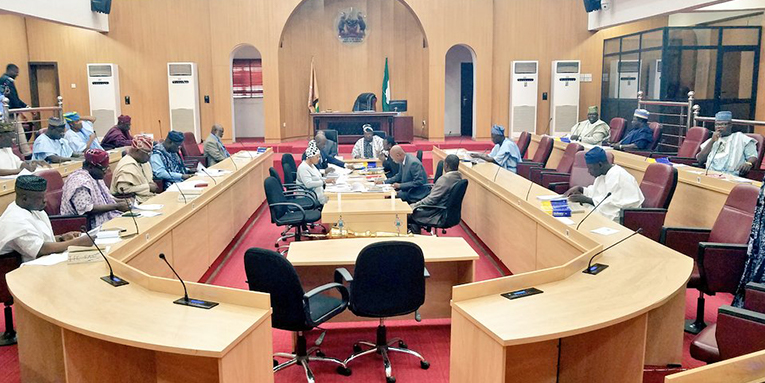
The nationwide campaign for decentralised policing gained fresh momentum on Monday as the Ondo State House of Assembly approved the constitutional amendment seeking to establish state police, adding its support to a major security reform that could fundamentally reshape Nigeria’s law enforcement system.
The lawmakers endorsed the Constitution of the Federal Republic of Nigeria, 1999 (Sixth Alteration) Bill, 2026, during plenary in Akure, following deliberations on the proposed legislation and its implications for security, governance and the protection of lives and property.
The bill, which seeks to provide a constitutional framework for the establishment of state police services, received the support of all lawmakers present during the sitting.
Its passage represents another significant endorsement of the proposed restructuring of Nigeria’s policing system, which currently places the Nigeria Police Force under federal control.
The development comes as the National Assembly advances efforts to amend the 1999 Constitution to allow the establishment of police formations at the state level, amid persistent concerns over insecurity, inadequate police coverage and the limitations of the existing centralised security structure.
The motion for the passage of the bill was moved by the Majority Leader of the Ondo Assembly, Olatunji Oshati, and seconded by the lawmaker representing Ese-Odo State Constituency, Allen Oluwatoyin.
Presenting the motion, Oshati said members had thoroughly examined the proposed constitutional amendment and considered its implications for citizens before endorsing it.
He maintained that establishing state police would strengthen Nigeria’s capacity to confront the numerous security challenges affecting communities across the federation.
The majority leader argued that the proposed arrangement would provide an opportunity for more effective security coordination and improve the ability of law enforcement agencies to respond to threats within their jurisdictions.
Speaking after the bill’s passage, the Speaker of the House, Olamide Oladiji, described the establishment of state police as a long-overdue reform whose implementation could enhance public safety.
Oladiji expressed confidence that policing structures operating closer to local communities would strengthen intelligence gathering, improve crime prevention and enable security personnel to respond more promptly to emergencies.
According to him, the existing security challenges confronting different parts of the country have reinforced the need to reconsider the organisation and operational reach of law enforcement agencies.
He said the proposed legislation could enable security agencies to respond swiftly to criminal activities and emerging threats.
“State policing would help reduce crime through improved intelligence gathering and proactive security measures,” the Speaker stated.
Oladiji further maintained that greater community involvement in policing could strengthen public confidence in security institutions.
He commended members of the Assembly for their contributions to the deliberations and their support for the proposed constitutional amendment.
Following the unanimous endorsement, the Speaker directed the Clerk of the House, Benjamin Jaiyeola, to forward the Assembly’s resolution and observations to the National Assembly for further legislative action.
The decision followed the earlier transmission of the proposed amendment to state legislatures by the National Assembly.
On September 16, 2026, the Clerk to the National Assembly, Kamoru Ogunlana, formally transmitted the Constitution (Sixth Alteration) Bill to the 36 state Houses of Assembly for consideration and approval.
The transmission formed part of the constitutional procedure required to alter provisions of the 1999 Constitution governing policing powers in Nigeria.
Ondo’s approval comes days after the proposed amendment secured the constitutionally required backing of at least 24 state Houses of Assembly.
The Presidential Working Group on the National Policing Bill, chaired by the Chief of Staff to the President, Femi Gbajabiamila, confirmed on October 23 that the proposal had achieved the two-thirds state legislative threshold required under Section 9 of the Constitution.
Separate reports indicated that as many as 25 state assemblies had endorsed the amendment before Ondo’s decision on Monday.
Under Section 9(2) of the 1999 Constitution, a constitutional alteration generally requires the support of at least two-thirds of the membership of each chamber of the National Assembly and approval through resolutions of no fewer than two-thirds of the 36 state legislatures.
This means that at least 24 state Houses of Assembly must support the proposal before it can complete the required constitutional process.
With Ondo joining the approving states, the proposed reform has gained additional legislative support beyond the minimum threshold.
However, Monday’s passage does not mean that Ondo State has immediately acquired its own operational police force.
The constitutional amendment must still complete the outstanding formal processes, while the eventual establishment of state police formations will require an appropriate legal, institutional and operational framework.
The proposal is intended to establish a dual policing arrangement under which federal and state police organisations would operate within constitutionally defined areas of responsibility.
It also seeks to change the constitutional allocation of policing powers to permit both federal and state legislative involvement in security administration.