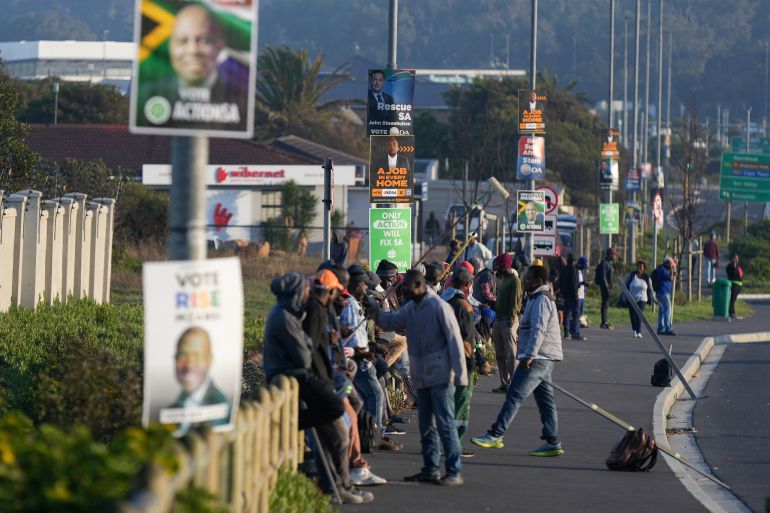
With barely two weeks to South Africa’s crucial municipal elections, growing public anger over electricity shortages, collapsing infrastructure and deteriorating public services is threatening the electoral fortunes of the ruling African National Congress (ANC), as frustrated residents vow to punish the party at the ballot box or boycott the polls altogether.
In several communities around Johannesburg, Africa’s leading industrial and commercial centre, years of unfulfilled promises have turned once-loyal ANC supporters into disillusioned voters, raising questions about the party’s ability to retain control of key municipalities in the November 4 elections.
For residents of Katlehong, a sprawling township on the outskirts of Johannesburg, the frustration is particularly deep.
For more than two decades, about 180 households have depended on illegal electricity connections, with dangerous cables running across footpaths and residential areas because authorities have failed to provide proper access to the national power grid.
Now, residents say they have endured enough.
“We have made a collective decision: no electricity, no vote,” community leader Lesiba Rankapole, 59, told AFP.
Rankapole acknowledged that the connections were illegal but insisted that residents had been left without a practical alternative.
“We know it is illegal, but we had no choice because we cannot live without electricity,” he said, warning that the persistent shortage was undermining children’s educational opportunities.
“Our children cannot progress without electricity.”
The resentment extends beyond electricity.
Across several ANC-controlled municipalities, residents complain about unreliable water supplies, overflowing sewage, uncollected refuse, deteriorating roads and allegations of corruption and financial mismanagement.
For Enock Majola, 57, the crisis has shattered a lifelong political loyalty.
“I was born ANC, but today I do not want anyone to tell me about the ANC because I am suffering,” he said.
Majola, who also complained about illegal refuse dumps in his community, declared that he would not support the party in the forthcoming elections.
His frustration reflects a broader challenge confronting the ANC, whose historic association with South Africa’s liberation struggle no longer guarantees electoral support in communities struggling with unemployment, poverty and inadequate basic services.
Once the dominant political force in post-apartheid South Africa, the ANC has experienced a sustained decline in electoral support over the past two decades.
The party, which produced the country’s first democratically elected president, Nelson Mandela, secured nearly 70 per cent of the national vote in 2004.
However, its support steadily weakened amid mounting criticism of governance failures, corruption scandals and deteriorating public infrastructure.
At the 2021 municipal elections, the ANC’s share of the vote fell to approximately 46 per cent, marking the first time it failed to secure an outright majority in a nationwide local government election.
The decline deepened during the 2024 general election when the party obtained just over 40 per cent of the vote, losing its parliamentary majority for the first time since the end of apartheid in 1994.
That historic setback forced it into a coalition government and fundamentally altered South Africa’s political landscape.
The November 4 municipal elections will provide another measure of the ANC’s support at the grassroots, where access to electricity, clean water, functioning roads and waste management often determines public perceptions of government performance.
The ruling party must also contend with established opposition parties and emerging political movements, including the uMkhonto weSizwe Party, led by former President Jacob Zuma, which will contest municipal elections for the first time.
Political analyst Sethulego Matebesi said municipal elections traditionally attract lower voter turnout, a development that has historically weakened the ANC’s electoral position.
According to him, the outcome will provide political parties with valuable insights into their support ahead of the 2029 national elections.
He also envisaged an electoral landscape in which coalition negotiations could become increasingly important as parties struggle to secure outright municipal majorities.
Johannesburg Becomes Major Political Battleground
Of the country’s 257 municipal councils, Johannesburg has emerged as one of the most closely watched contests.
Home to more than 4.8 million people, the city is South Africa’s principal economic centre and a symbol of both the country’s commercial strength and its profound social inequalities.
Nowhere are those contradictions more visible than in Alexandra, a densely populated township situated within sight of Sandton, one of Africa’s wealthiest business districts.
While Sandton’s skyscrapers reflect the country’s financial power, neighbouring Alexandra continues to struggle with damaged roads, overflowing sewage systems, refuse dumps and inadequate public infrastructure.
For many residents, the contrast has become a powerful illustration of the distance between South Africa’s economic potential and the living conditions experienced by poorer communities.
“The ANC has been governing for years, but we have not seen any changes in Alexandra,” said Patrick Saohatse, 45, a maintenance worker.
Saohatse said he intended to support the Democratic Alliance (DA), the country’s principal opposition party and the ANC’s largest partner in the national coalition government.
The DA, which governs Cape Town, has placed municipal service delivery and allegations of mismanagement at the centre of its Johannesburg campaign.
Its mayoral candidate, 75-year-old Helen Zille, has warned that continued infrastructure deterioration could deepen the city’s problems.
“Another five years of corruption and collapsing infrastructure will push our city beyond recovery,” she told supporters at a recent campaign rally.
The race also features Herman Mashaba, 67, leader of the centre-right ActionSA, who is seeking a return to the Johannesburg mayoralty.
Mashaba has criticised the city’s deteriorating infrastructure and inconsistent waste collection.
“Our refuse collection is irregular; our streets have no lights… I keep asking myself, what on earth is happening?” he said.
ANC Admits Failures, Appeals For Another Chance
With the elections approaching, the ANC has acknowledged public dissatisfaction with service delivery while maintaining that it remains capable of addressing the country’s municipal challenges.
The party’s head of elections, Mdumiseni Ntuli, conceded that residents had legitimate grounds for frustration.
“If you look at the situation in and around Johannesburg, there are reasons for people not to be happy,” Ntuli told AFP.
He also acknowledged the party’s governance shortcomings but maintained that the ANC remained a better choice for voters.
“We have made mistakes and accepted our shortcomings, but ANC remains a better option for people,” he said.
The party’s difficulties have been compounded by uncertainty surrounding its Johannesburg mayoral candidate, who had yet to be selected less than two weeks before polling day, according to the report.
Despite the growing resentment, political loyalties remain complicated.
In another part of Katlehong, 58-year-old Meshack Twala was attempting to clear a blocked sewage pipe outside a house surrounded by wastewater.
He questioned why residents should participate in an election when their neighbourhood had endured persistent sanitation problems.
Yet, unlike some of his neighbours, Twala admitted that he would probably still vote ANC if he went to the polling station.
“Changing to other parties would not feel right,” he said.
His dilemma captures one of the defining tensions of the election: the struggle between longstanding political loyalty and mounting dissatisfaction with everyday living conditions.
South Africa’s Electoral Commission has confirmed November 4 as the election date, with preparations under way for voting across the country’s municipalities.
For the ANC, the stakes extend beyond the control of local councils. The elections will offer another indication of whether the party can rebuild public confidence after losing its national majority in 2024, while giving its opponents an opportunity to demonstrate their support at the municipal level.
As South Africa approaches another defining electoral contest, the message from neglected townships is becoming increasingly difficult for political leaders to ignore: liberation-era loyalty is being tested against the realities of daily survival. For residents living without reliable electricity, clean streets and functioning sanitation, the ballot is no longer simply about political history. It is about whether those entrusted with power can deliver the basic services democracy promised.