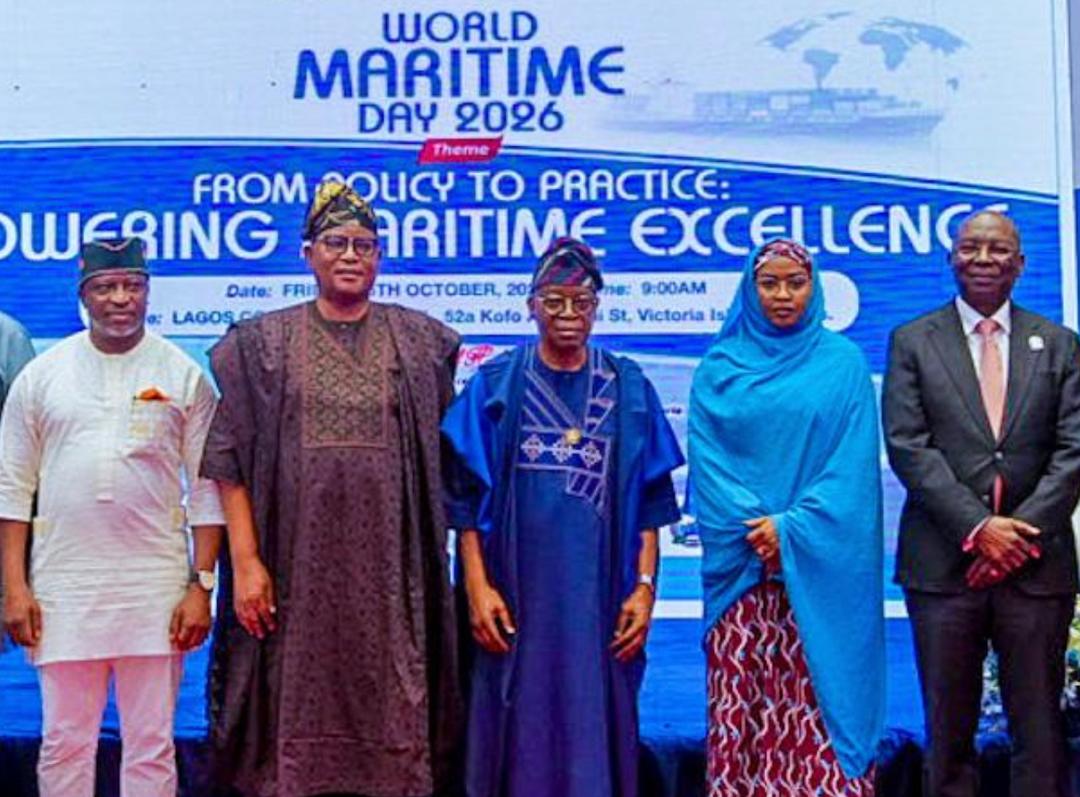
*Oyetola Reiterates FG’s Commitment To Modernising Ports Outside Lagos
*Assures Indigenous Shipowners Of Commitment To CVFF Disbursement
*Unveils Gazetted NPERA Act, Logo, Reaffirms Commitment
The Federal Government is stepping up efforts to produce globally competitive Nigerian seafarers through expanded training, professional certification and practical onboard experience, Minister of Marine and Blue Economy, Dr. Adegboyega Oyetola, has said.
Oyetola disclosed this on Friday at the 2026 World Maritime Day celebration held at the Lagos Continental Hotel, Victoria Island, Lagos, describing skilled manpower development as critical to Nigeria’s ambition to strengthen its position in the global maritime industry.
The event was held under the theme, “From Policy to Practice: Powering Maritime Excellence.”
“We are expanding seafarer training, certification and practical sea-time opportunities in line with international standards,” the minister said.
He highlighted the partnership between Nigeria LNG Limited (NLNG) and the Maritime Academy of Nigeria, Oron, including a sea-time training memorandum of understanding aimed at helping cadets acquire the onboard experience required for professional certification.
“Together with wider seafarer training and placement initiatives, this is building a skilled Nigerian maritime workforce ready to compete globally,” he said.
Oyetola said the government was also strengthening fisheries colleges and research institutions to equip young Nigerians and women with practical skills in aquaculture, fish processing, marine technology and sustainable fisheries management.
“Through improved training, research and industry partnerships, we are equipping young Nigerians, women and fishing communities with the skills to increase productivity, create enterprises and contribute to national food security,” he said.
Beyond manpower development, the minister said the Federal Government was intensifying efforts to improve maritime security, following the lifting of longstanding United States Coast Guard Condition of Entry restrictions affecting vessels arriving from Nigerian ports.
Oyetola noted that the achievement has far-reaching economic implications because the overwhelming majority of Nigeria’s international trade by volume moves by sea.
“Reducing security-related burdens and delays will lower shipping and logistics costs, strengthen the competitiveness of our businesses and, as savings move through the supply chain, help reduce the cost of goods and services for Nigerians,” he said.
On port infrastructure, Oyetola said the government was advancing modernisation projects at Onne, Warri and Calabar ports, building on developments at Apapa and Tin Can Island, while pursuing deep seaport projects at Agge, Bakassi, Bonny, Gateway, Ibom and Ondo.
He said the strategy was designed to expand capacity, improve efficiency and reduce the pressure on Lagos by connecting seaports to inland dry ports and production centres through road, rail and inland waterways.
In fisheries and aquaculture, Oyetola disclosed that fish production rose from approximately 1.1 million metric tonnes to 1.4 million metric tonnes in 2025. He said the government was building on the progress through responsible aquaculture, improved processing, cold-chain investment and better market access.
The event was attended by the Chairman of the Senate Committee on Marine Transport, Senator Wasiu Eshinlokun; Deputy Chairman of the House of Representatives Committee on Maritime Safety, Education and Administration, Hon. Odudoh Uduak; heads of maritime agencies and other industry stakeholders.
In his goodwill message, Eshinlokun called for an end to attacks on seafarers in the Strait of Hormuz. The celebration also featured the presentation of prizes to winners of an essay competition organised by agencies under the Federal Ministry of Marine and Blue Economy.
Meanwhile, Oyetola, has reassured Nigerians of the Federal Government’s commitment to modernising ports outside Lagos as part of efforts to strengthen the country’s maritime infrastructure, improve trade efficiency and stimulate economic activities across the federation.
Oyetola gave the assurance on Friday at the 2026 World Maritime Day celebration, reaffirming the government’s resolve to develop a more balanced network of maritime gateways across the country.
He said the ongoing drive to modernise Nigeria’s ports remained a critical component of the Federal Government’s blue economy agenda, with particular attention to improving the capacity and efficiency of existing facilities beyond Lagos.
The minister identified Onne, Warri and Calabar ports as part of the modernisation programme, which complements efforts at Apapa and Tin Can Island ports. He also reiterated the government’s commitment to its deep seaport development agenda, covering proposed projects at Agge, Bakassi, Bonny, Gateway, Ibom and Ondo.
“This is a deliberate effort to expand capacity, improve efficiency and build a more balanced national network of maritime gateways,” Oyetola said.
He explained that the broader vision of the Ministry is the effective connections between seaports, inland dry ports and production centres through an integrated network of roads, railways and inland waterways.
“By linking our seaports to Inland Dry Ports and production centres through an integrated multimodal network of road, rail and inland waterways, we are bringing cargo closer to producers and consumers, reducing haulage costs, easing pressure on Lagos, strengthening exports and stimulating industrial and logistics clusters across the Federation,” he said.
Oyetola further stressed that Nigeria’s maritime development agenda extended beyond coastal communities, noting that inland ports and waterways, including Onitsha and Baro, remained important to connecting businesses and production centres to national and international markets.
He said the government was working with relevant agencies and investors to ensure that its port development objectives translated into functional infrastructure, efficient cargo handling, navigable channels and dependable transport connections.
The minister also highlighted the Nigerian Ports Economic Regulatory Agency Act, 2026, as part of ongoing efforts to strengthen economic regulation, promote fair competition and improve service delivery across the port system.
He maintained that sustained investment in port infrastructure and improved connectivity would help reduce logistics costs, encourage investment, support exports and create employment opportunities across different parts of the country.
In another development, Oyetola, has unveiled the newly gazetted Nigeria Ports Economic Regulatory Agency (NPERA) Act, 2026, alongside the agency’s official logo, describing the development as a significant milestone in efforts to strengthen port regulation, boost investor confidence and enhance Nigeria’s maritime competitiveness.
The minister said the enactment of the NPERA Act, following President Bola Ahmed Tinubu’s assent in June 2026, established a substantive statutory framework for port economic regulation after nearly two decades of efforts to institutionalise the function.
He disclosed that he had directed the immediate constitution of a ministerial committee to oversee the transition of the Nigerian Shippers’ Council, which had served as interim port economic regulator since 2014, into the new agency.
According to him, NPERA will be responsible for regulating tariffs and charges, promoting competition, enforcing service standards, resolving commercial disputes and protecting port users’ interests.
“The credibility of an economic regulator rests, in no small measure, on its independence, impartiality and freedom from responsibilities that could give rise to actual or perceived conflicts of interest,” Oyetola said.
He directed the agency to operate as an impartial arbiter, free from competing regulatory and operational responsibilities.
On port infrastructure, the minister highlighted plans to modernise Apapa, Tin Can Island, Onne, Rivers, Delta and Calabar ports, stressing that the programme would ensure balanced development across the country.
“No part of our national port system will be left behind in this modernisation programme,” he declared, adding that ports outside Lagos were equally important to Nigeria’s economic future.
He also disclosed that the Federal Government had approved the development of the Ibom, Bakassi, Agge, Gateway, Ondo and Bonny Deep Seaports to expand maritime capacity and strengthen Nigeria’s position as a regional logistics hub.
On maritime security, Oyetola said Nigeria had maintained zero piracy incidents in its territorial waters through the Deep Blue Project. He described the lifting of the 12-year United States Coast Guard Condition of Entry on vessels arriving from Nigeria in August 2026 as a major achievement.
The development, he said, reflected progress in maritime security and compliance with the International Ship and Port Facility Security Code.
The minister further reaffirmed the government’s commitment to indigenous shipping, disclosing that he had directed the Nigerian Maritime Administration and Safety Agency to work with approved Primary Lending Institutions to accelerate the processing and disbursement of the Cabotage Vessel Financing Fund to qualified applicants.
Emphasising international cooperation, the minister cited Nigeria’s election to Category C of the International Maritime Organization Council in November 2025 and ongoing engagements with Denmark, India, Norway and the United Kingdom.
“Our approach to international cooperation is purposeful and results-oriented,” he said, noting that partnerships must strengthen local capabilities and deliver measurable, sustainable outcomes.
The Ambassador, Embassy of the Kingdom of Denmark in Nigeria, Jens Ole Bach Hansen, did a presentation on Denmark’s Experience in Building a Sustainable Blue Economy: Lessons for Strategic Partnerships, Investment and Technology Transfer with Nigeria.”
Similarly, Oyetola, reaffirmed the Federal Government’s commitment to strengthening indigenous shipping capacity, assuring Nigerian shipowners of sustained support and promising his commitment to the disbursement of the Cabotage Vessel Financing Fund (CVFF) to qualified applicants.
The minister said the administration remained committed to the effective implementation of the Coastal and Inland Shipping (Cabotage) Act to ensure that Nigerians participate fully in the ownership and operation of vessels engaged in domestic maritime trade.
“To our indigenous shipowners, I wish to reaffirm this Administration’s commitment to the development of indigenous shipping capacity and the effective implementation of the Coastal and Inland Shipping (Cabotage) Act,” he said.
As part of efforts to address longstanding concerns over access to financing, Oyetola disclosed that he had directed the Nigerian Maritime Administration and Safety Agency (NIMASA) to work closely with approved Primary Lending Institutions (PLIs) to accelerate the processing and disbursement of the CVFF to eligible beneficiaries.
“Progress may require patience, but our direction remains firm,” the minister stated, underscoring the administration’s determination to advance the fund’s implementation.
The CVFF is regarded as a critical financing instrument for supporting Nigerian shipowners and expanding indigenous participation in the maritime industry. Its effective deployment is expected to strengthen the national fleet and improve local capacity to compete in the domestic shipping market.
According to Oyetola, the benefits of the fund extend beyond vessel acquisition to other segments of the maritime value chain, including shipbuilding, marine engineering, vessel maintenance and maritime logistics.
He stressed that developing indigenous shipping capacity remained central to the government’s broader objective of ensuring that Nigerians derive greater economic benefits from the country’s maritime resources.
“The effective deployment of the CVFF has the potential to strengthen our indigenous fleet and stimulate investment across the maritime value chain,” he said.
The minister also highlighted the importance of professional training, local expertise development, support for indigenous businesses and strategic investment in building a competitive domestic maritime industry.
“Our ultimate objective is to build an industry in which Nigerians possess the opportunities, capabilities and resources to own, operate and lead,” he added.