- Cites US Investment Climate Warning, Questions Gap Between Macroeconomic Stability, Productive Capital Inflows
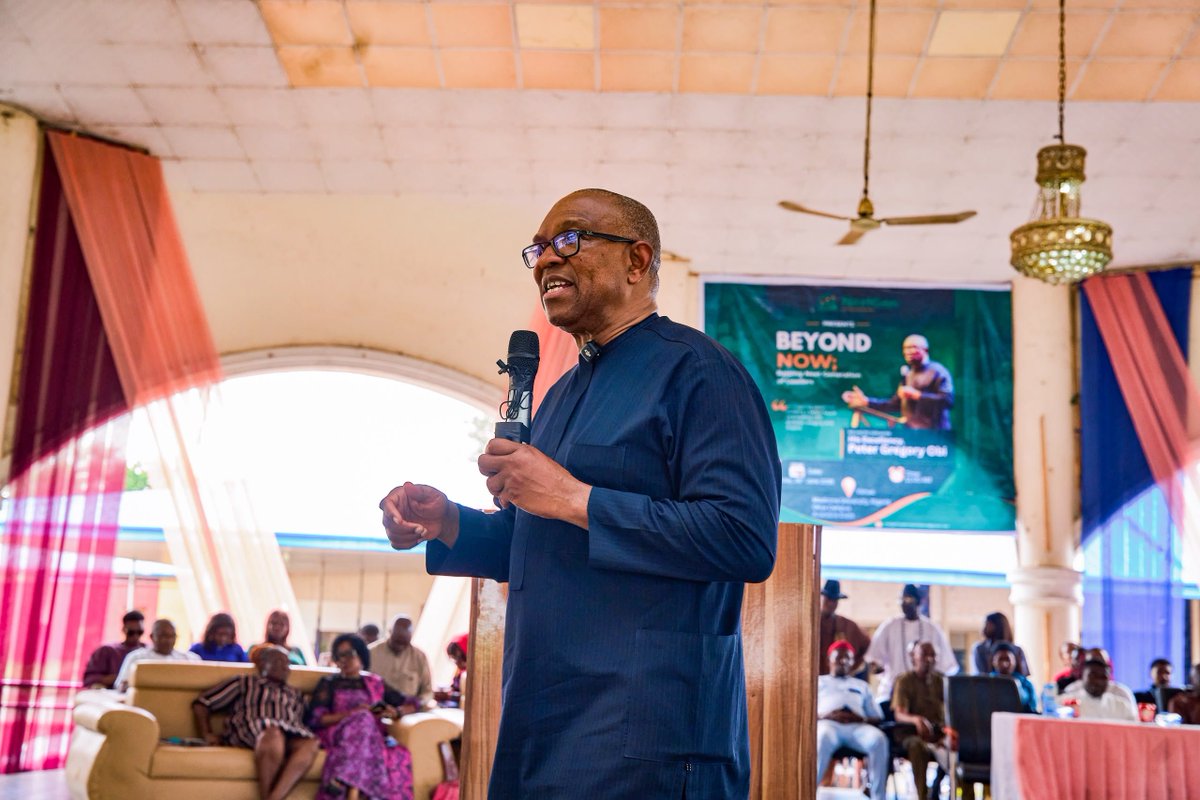
Presidential candidate of the Nigeria Democratic Congress (NDC), Peter Obi, has launched a blistering attack on President Bola Tinubu’s administration, accusing it of undermining Nigeria’s ability to attract foreign investment even as the Federal Government celebrates signs of macroeconomic stability.
Obi described the situation as a national embarrassment, arguing that the government’s claims of economic progress are contradicted by persistent structural problems that continue to weaken investor confidence.
In a statement issued on Wednesday, October 14, 2026, titled “Scaring Investors While Celebrating Macroeconomic Stability,”the former Anambra State governor challenged the administration to move beyond celebrating economic indicators and confront the institutional failures, insecurity and business bottlenecks discouraging long-term investment.
“It is paradoxical that while the Tinubu administration is celebrating macroeconomic stability, it is unwittingly scaring away foreign investors. What a shame,” Obi declared.
The NDC candidate’s intervention followed concerns raised in the United States Department of State’s 2026 Nigeria Investment Climate Statement, which identified corruption, insecurity, inconsistent regulatory enforcement, weaknesses in the judicial system, power supply problems and delays at the country’s ports among factors affecting the business environment.
Obi argued that the warning should have triggered an urgent response from the Presidency, including investigations into the concerns raised and concrete measures to address the problems rather than continued celebration of the administration’s economic reforms.
He accused the All Progressives Congress (APC)-led government of failing to create the conditions necessary to attract foreign direct investment, insisting that Nigeria’s enormous market and economic potential were not being adequately translated into productive capital inflows.
In a stinging assessment, he said: “Unfortunately, our incompetent APC-led government cannot give what they don’t have, as they are the real perpetrators of the issues raised by the U.S. Government.”
The Presidency has consistently defended its economic reforms as necessary to restore stability, strengthen public finances and improve investor confidence. In his October 1 Independence Day address, Tinubu said the economy had grown by more than four per cent in 2026, while inflation had declined from its peak and foreign reserves had strengthened. He also maintained that foreign direct investment continued to rise annually.
But Obi questioned whether such improvements could be regarded as sufficient progress when the country was still struggling to attract the kind of long-term investment capable of expanding industrial production, creating jobs and improving living standards.
$10.37bn inflow, but only $135m in direct investment
Central to Obi’s criticism is the composition of Nigeria’s capital importation in the first quarter of 2026.
According to figures he cited, Nigeria recorded total capital importation of $10.37 billion during the period, but only $135.08 million came through foreign direct investment (FDI), representing approximately 1.3 per cent of the total.
By contrast, foreign portfolio investment accounted for about $9.86 billion, or approximately 95.1 per cent, while loans and other capital streams made up the remainder.
The figures, Obi argued, expose a fundamental weakness in the country’s investment profile: large capital inflows do not necessarily translate into a comparable volume of long-term productive investment.
Foreign direct investment typically involves a lasting interest in businesses, factories, infrastructure and other productive ventures. Such investments can expand productive capacity, introduce technology, create employment and strengthen supply chains.
Portfolio investments, on the other hand, largely involve financial assets such as shares and bonds. Although they can deepen financial markets and provide capital, they may be more sensitive to interest rates, exchange-rate movements and changing investor sentiment.
For Obi, the imbalance raises questions about whether Nigeria is attracting enough investors willing to commit capital to long-term economic activity rather than predominantly seeking financial returns.
He maintained that the country’s market size, population and resource base should make it a stronger destination for productive investment, but argued that these advantages would remain underutilised without credible institutions, predictable regulations and a secure operating environment.
US warning puts business climate under scrutiny
The US investment climate assessment has added another dimension to the debate over Nigeria’s economic direction.
The concerns highlighted in the report extend beyond headline economic indicators to the practical conditions confronting businesses operating in the country.
Corruption and inconsistent regulatory enforcement can increase uncertainty over the cost and predictability of doing business. Weak judicial institutions can make the enforcement of contracts and resolution of commercial disputes more difficult, while insecurity raises the cost of protecting personnel, facilities and supply chains.
Infrastructure deficiencies, especially unreliable electricity and inefficient cargo handling, can also increase operating costs and undermine the competitiveness of Nigerian businesses.
Obi argued that a country seeking substantial foreign investment cannot afford to ignore such warnings, particularly when competing with other emerging markets for limited international capital.
He said a government committed to improving Nigeria’s global economic standing should respond to adverse investment assessments with prompt investigations, measurable reforms and effective follow-through.
The former governor also criticised what he described as the administration’s failure to acknowledge the seriousness of the issues identified by the US government.
According to him, Nigeria must address the underlying conditions responsible for negative investment perceptions instead of treating macroeconomic stability as proof that the business environment is already healthy.
Macroeconomic gains versus business realities
The dispute exposes a growing divide over how the success of Tinubu’s economic reforms should be measured.
Since taking office in May 2023, Tinubu has pursued major policy changes, including the removal of petrol subsidy and reforms to the foreign exchange regime. The administration has argued that these measures were necessary to correct longstanding distortions, improve government finances and establish a more sustainable economic foundation.
The reforms have, however, imposed substantial adjustment costs on households and businesses, with higher fuel and transportation expenses affecting production, distribution and consumer spending.
Tinubu has defended the measures as difficult but necessary steps, maintaining that the government is laying the foundation for wider prosperity.
Obi’s criticism centres on whether the improvements reported in selected macroeconomic indicators are being matched by a business environment capable of generating investment, jobs and higher productivity.
For the opposition candidate, the distinction is critical: economic stability may improve the conditions for investment, but it cannot by itself guarantee that investors will commit money to factories, infrastructure, technology or other productive ventures.
The challenge for the government, therefore, is not only to sustain improvements in inflation, reserves and economic growth, but also to demonstrate that the country is becoming a more predictable, secure and efficient place to do business.
Ports, power and insecurity compound investor concerns
Obi’s intervention has also brought renewed attention to the operational difficulties confronting businesses, particularly in electricity supply, logistics, security and regulatory administration.
Nigeria’s traditional ports at Apapa and Tin Can Island have long faced congestion and cargo-clearance delays. The US assessment cited by Obi highlighted cargo dwell times exceeding 20 days at the ports, while describing port inefficiency as an additional cost burden on investors. The report also acknowledged the contribution of the Lekki Deep Seaport to easing pressure on the maritime trade system.
For manufacturers and import-dependent businesses, delays at the ports can increase demurrage charges, tie up working capital and disrupt production schedules.
Unreliable electricity supply similarly forces many companies to rely on alternative power sources, adding to operating costs and affecting their ability to compete with producers in countries with more dependable infrastructure.
Security concerns present another challenge, particularly for businesses that depend on nationwide distribution networks, agricultural supply chains and movement of personnel across different regions.
Obi argued that these problems require direct government intervention, insisting that Nigeria’s economic potential cannot be fully realised while businesses continue to contend with avoidable operational obstacles.
Tinubu faces test of translating stability into investment
The controversy comes as the administration seeks to persuade Nigerians and international investors that its economic reforms are beginning to deliver sustainable results.
The government has pointed to improved macroeconomic conditions and stronger public finances as evidence that its policy direction is working. Obi, however, contends that the composition of capital inflows and the concerns raised by the US investment climate assessment show that major weaknesses remain unresolved.
The two positions underscore the difference between establishing macroeconomic stability and building an economy that consistently attracts long-term productive investment.
For Nigeria, the stakes extend beyond the political contest between the ruling APC and opposition parties. Foreign investment can help finance industrial expansion, support technology transfer, create jobs and improve productivity, provided it is directed towards viable enterprises and accompanied by sound institutions and infrastructure.
Addressing investor concerns would therefore require more than reassuring statements. It would involve improving regulatory predictability, strengthening the justice system, tackling corruption, reducing insecurity, improving electricity supply and making the movement of goods through the ports more efficient.
Obi concluded his statement with a message of optimism about the country’s prospects, despite his criticism of the administration.
His challenge to Tinubu is unmistakable: if the government is serious about turning macroeconomic stability into broad-based prosperity, it must convince investors that Nigeria is not merely a market with enormous potential, but also a country where capital can operate securely, predictably and profitably.