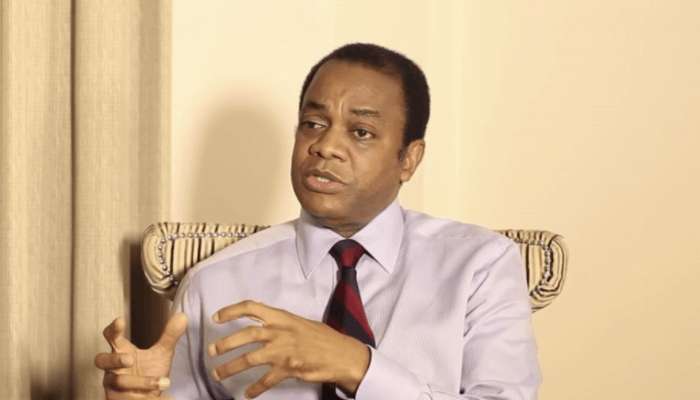
Former Cross River State governor and presidential candidate of the Peoples Redemption Party, Donald Duke, has called for the creation of state and local government police formations, arguing that Nigeria’s centralised security structure has failed to effectively tackle terrorism, kidnapping, banditry and other violent crimes.
Duke said security operations must be brought closer to communities because local intelligence, rather than only military or police deployments after crimes occur, remained critical to preventing attacks.
Speaking on the state of Nigeria’s security architecture, the former governor said the country had not significantly redesigned its policing system since the end of the Civil War in 1970.
“You really have not updated your security architecture since 1970. It is only recently that more military divisions were created, but anything that is essential must be local. You have to localise it,” he said.
Duke supported the establishment of state police and, where necessary, local government police, but stressed that such reforms must be accompanied by judicial safeguards to prevent misuse.
“You have got to decentralise your policing. The idea of state police, even local government police, is right. Have it and set the guidelines, but you must strengthen the judiciary because there must be an institution everyone reports to when things go wrong,” he stated.
The PRP presidential candidate dismissed concerns that state police could become tools for political intimidation by governors, arguing that similar allegations had been raised against the existing federal police structure.
“If you say state police will be abused, the national police will also be abused by the president. It is not only governors who can abuse the police. Set it up and put stringent guidelines in place,” Duke said.
He explained that intelligence gathering should be the primary responsibility of decentralised police formations, noting that residents were better positioned to identify threats within their communities.
“Eighty per cent of security is intelligence. You cannot be in Sokoto and expect to know what is happening in Calabar. You need local people to gather that intelligence,” he said.
According to him, enforcement activities represent only a smaller part of effective policing, while information gathering remains the foundation of crime prevention.
“Only about 20 per cent of policing is enforcement. Their main preoccupation should be intelligence gathering,” he added.
Duke also criticised Nigeria’s inability to penetrate terrorist groups such as Boko Haram after years of insurgency.
“It is a shame that after almost 20 years of Boko Haram, we don’t have adequate intelligence on them. We have not infiltrated their ranks. We ought to have infiltrated their ranks by now to know what they will do next,” he said.
Drawing comparisons with other countries, Duke cited the United States’ National Guard system, where states have locally based security formations operating within a defined federal framework.
“In the United States, they have what they call the National Guard, which is military and it is in every state. It is really like having a division in every state. They have decentralised security,” he said.
Beyond policing reforms, Duke linked insecurity to poverty and lack of economic opportunities, arguing that criminal networks often attract young people in deprived communities.
He referenced historical violent movements, including the Maitatsine uprising of the late 1970s and early 1980s, saying extreme poverty had often created conditions where such groups could gain influence.
“The northeastern part is the poorest part of the North. You find that those things are exacerbated in those areas. Now, it is creeping all over the North and coming down South,” he said.
Duke argued that the financial rewards associated with criminal activities had made the fight against kidnapping and banditry more complex.
“A kidnapper kidnaps someone and gets N20 million. You then tell him to take a steady job that pays N250,000. It cannot work,” he said.
He maintained that security reforms must go hand in hand with education, employment opportunities and economic empowerment.
According to him, the ultimate responsibility of government is to create an environment where citizens can be productive and live safely.
“The reason we need a government is to ensure the utmost productivity of our citizens within a safe and orderly environment. If people are productive and the environment is safe, what more should the government do? That is the foundation of a stable country,” Duke said.