- Warns That Africa Can No Longer Bear UN Security Council Consequences Without Permanent Seat
- Says 2026 World Cannot Remain Captive To 1945 Power Structure
- Calls For Debt, Climate Finance Reforms
- Urges Global War On Terrorism, Cybercrime
President Bola Ahmed Tinubu has mounted a fresh, forceful demand for a fundamental overhaul of the United Nations, declaring that the global body’s reform must begin with the restructuring of the Security Council to give Africa permanent representation and veto power.
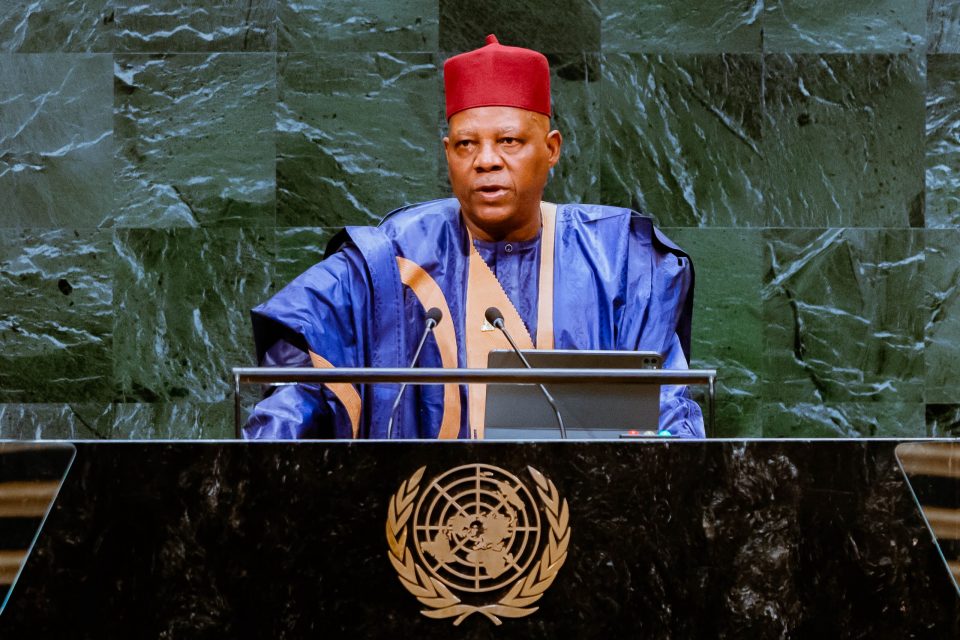
Tinubu made the demand on Thursday in his national address to the 81st United Nations General Assembly in New York, delivered on his behalf by Vice-President Kashim Shettima.
The President said the existing global power structure, shaped in the aftermath of the Second World War, could no longer adequately reflect the realities of the contemporary world.
“The reform of this institution must begin with the reconstitution of the Security Council, for the world of 2026 cannot remain captive to the distribution of power in 1945,” Tinubu declared.
He insisted that Africa could no longer continue to shoulder the consequences of decisions taken by the UN Security Council while remaining excluded from its permanent membership.
“Africa cannot continue to fill the Council’s agenda while remaining absent from its permanent membership,” the President said.
Tinubu called for at least two permanent seats for Africa, with all the rights and responsibilities attached to permanent membership, including veto power for as long as the veto exists, as well as five non-permanent seats for the continent
“The authority to speak for humanity carries an obligation to represent it,” he said.
The President’s address placed Nigeria’s long-standing campaign for greater African representation at the heart of his vision for a reformed multilateral system. Nigeria has previously pressed the case for African permanent representation on the Security Council as part of broader UN reforms.
‘Nigeria Ready For Greater Responsibility’
Tinubu also presented Nigeria as a country prepared to assume greater responsibilities in global peace and security, citing its decades-long involvement in peacekeeping and regional conflict resolution.
He pointed to Nigeria’s roles in Liberia, Sierra Leone, Darfur, Mali and The Gambia, as well as its activities through the Economic Community of West African States, African Union and Gulf of Guinea partnerships.
“Nigeria stands ready to assume greater responsibility on the strength of obligations honoured and sacrifices made over decades in the service of peace,” he said.
But the President warned that modern security threats had outgrown national boundaries, stressing that terrorism, organised crime, cyberattacks and illicit financial networks were exploiting gaps between countries.
He called for intensified intelligence sharing, stronger institutions and coordinated action to choke the financial and logistical lifelines of violent groups.
“Our common security therefore demands cooperation equal to the reach of the threats before us,” Tinubu said.
“We must exchange intelligence, strengthen institutional capacity, interrupt the financing of violence and prevent weapons from crossing borders that our responses too often fail to cross.”
The President said Nigeria’s experience in confronting Boko Haram, ISWAP and other armed groups had demonstrated that military action alone could not guarantee lasting peace.
“Military victories require enduring foundations in education, economic opportunity, accountable governance and communities whose rights and dignity are protected,” he said.
His call for greater cross-border cooperation comes amid continuing concerns over insecurity across the Sahel, where instability has implications for neighbouring states, trade, population movements and regional integration.
Tinubu Tackles Sudan, Global Conflicts
On the conflicts in Sudan and other troubled regions, Tinubu urged the international community to return to diplomacy and negotiated settlements.
He demanded protection for civilians and unhindered humanitarian access, insisting that no security claim should justify attacks on vulnerable populations.
“Within and beyond our continent, no claim to security can justify starving children, denying relief to civilians or erasing communities from the land they call home,” he said.
He added: “We place our faith in diplomacy because military victories alone cannot secure lasting peace.”
According to Tinubu, the UN must place greater emphasis on peacebuilding, mediation, institution-building and conflict prevention rather than concentrating predominantly on peacekeeping after conflicts have already erupted.
‘Development And Climate Action Are Not Opposites’
The President also rejected what he described as a false choice between economic development and climate action, arguing that developing nations must be allowed to industrialise while pursuing lower-carbon development pathways.
“We reject the false choice between development and climate action,” Tinubu said.
He noted that Africa contributes less than four per cent of global greenhouse gas emissions but faces disproportionate consequences from climate change.
Nigeria, he said, remained committed to the Paris Agreement and an equitable energy transition, while maintaining its target of achieving net-zero emissions by 2060.
Under the Energy Transition Plan, Tinubu said Nigeria would combine renewable energy, clean cooking, gas as a transitional fuel, climate-smart agriculture and nature-based solutions.
But he demanded predictable international climate financing, technology transfer and capacity building for developing countries.
“Finance must be governed by equity and shared responsibility rather than charity,” he declared.
Tinubu: Don’t Surrender AI Future To Fear
The President also delivered a strong defence of responsible technological innovation, particularly artificial intelligence, warning against allowing fear to derail the potential benefits of emerging technologies.
“We refuse to surrender our technological future to paranoia,” Tinubu said.
Using an analogy, he explained that the same invention could be used for destruction or human advancement depending on the purpose and judgement of those controlling it.
“We can deploy artificial intelligence to wage war or use it to transform healthcare, education, agriculture, governance and economic productivity,” he said.
Tinubu said Nigeria was investing in digital public infrastructure, broadband connectivity, innovation ecosystems, research institutions and technology entrepreneurship.
He invited the international community to partner with Nigeria’s young technology entrepreneurs to deploy AI towards human development rather than destruction.
Debt Crisis: Tinubu Demands New Financial Architecture
The President also used the global platform to demand reforms to the international financial system, warning that debt servicing was consuming resources that developing countries needed for education, healthcare and infrastructure.
“One of the greatest obstacles to sustainable development is inadequate financing,” he said.
Tinubu called for wider access to concessional financing and debt sustainability frameworks that take the developmental needs of poorer countries into account.
He also advocated private capital, blended finance, South-South cooperation and strategic partnerships to fund infrastructure, climate adaptation and sustainable development.
‘Africa Must Stop Exporting Raw Materials’
Tinubu further placed the African Continental Free Trade Area at the centre of his economic vision for the continent.
He said AfCFTA could strengthen regional value chains, increase intra-African trade, accelerate industrialisation and attract investment.
But he warned that Africa must break away from its traditional dependence on exporting raw materials.
“Africa must move beyond its historical role as an exporter of raw materials towards greater value addition, manufacturing, technological innovation and knowledge-driven growth,” he said.
“Our abundant natural resources must become engines of shared prosperity rather than sources of perpetual dependency.”
‘Humanity Is Our Oldest Citizenship’
In a sweeping conclusion, Tinubu called for a UN capable of responding to the changing realities of the 21st century, arguing that institutions that refuse to adapt risk losing their relevance.
He pledged that Nigeria would continue to favour diplomacy, cooperation and multilateral engagement.
“Nigeria pledges to choose cooperation over confrontation, dialogue over division, hope over fear and partnership over isolation,” he declared.
“The world looks to this Assembly for leadership, and our debates must lead to action worthy of that expectation.”
The President ended with an appeal for unity that underscored the central message of his address.
“Whatever our differences, we must remember that humanity is our oldest citizenship, and peace is the inheritance we owe every child,” Tinubu said.
The intervention also builds on Nigeria’s previous calls for Security Council reform and a permanent African presence, including Nigeria’s stated demand for permanent representation with veto rights.