
News
Why We Cannot Fix Petrol Pump Prices, NMDPRA Declares, Cites Section 205 PIA

- Midstream, Downstream Regulator Says Federal Law Forbids Return to Price Caps Without Declared Market Failure
- Agency Admits Severe Household Strain as Squeeze Follows Sharp Increases Across Filling Stations
- Enlists Customs and Consumer Protection Watchdog to Combat Cross-Border Smuggling, Cartels, and Faulty Meters
The Nigerian Midstream and Downstream Petroleum Regulatory Authority has told Nigerians demanding a return to regulated fuel prices that its hands are tied by federal statute, insisting it cannot fix petrol pump prices or reintroduce administrative pricing templates.
The regulator made the clarification on Saturday in a public statement released via its verified X handle, pushing back against mounting calls from civil society, labour unions, and opposition politicians for the federal government to cap soaring retail fuel prices.
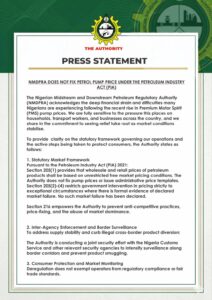
At the core of the agency’s position is Section 205(1) of the Petroleum Industry Act 2021. Under this section, wholesale and retail prices of petroleum products in Nigeria must be determined entirely by unrestricted, open-market forces.
The law leaves almost no room for price-fixing.
While Sections 205(2) through 205(4) allow the government to intervene in pump prices during exceptional circumstances, the intervention can only occur if there is formal evidence of a declared market failure.
According to the downstream regulator, no such market failure has been declared anywhere in the country.
“The authority does not fix pump prices or issue administrative price templates,” the agency said.
The NMDPRA nonetheless conceded that the escalating cost of petrol is battering domestic household budgets.
“The NMDPRA acknowledges the deep financial strain and difficulties many Nigerians are experiencing, following the recent rise in petrol pump prices,” the authority stated, adding that it remained sensitive to the cost pressures weighing down transport operators, small businesses, and families.
However, the regulator cautioned oil marketers against misinterpreting full deregulation as a licence to run exploitative cartels.
Under Section 216 of the PIA, the agency remains empowered to police the market for anti-competitive conduct, collusive price-fixing, and the abuse of market dominance.
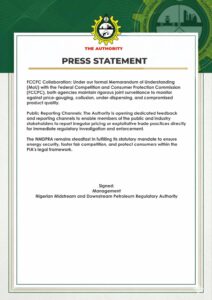
To rein in retail malpractice, the NMDPRA announced it has activated a joint monitoring protocol with the Federal Competition and Consumer Protection Commission. Field operatives from both agencies are inspecting retail forecourts across the 36 states and Abuja to clamp down on pump under-dispensing, adjusted meters, and the distribution of adulterated fuel.
The agency is also turning its attention to the frontiers, where fuel price differentials with neighbouring countries continue to fuel cross-border contraband.
A joint border surveillance operation has been set up alongside the Nigeria Customs Service and allied security agencies to intercept smuggled product trucks along border corridors, an illicit trade that drains domestic supplies and triggers local scarcities.
The regulator stated that while it cannot order price drops at the pump, it will keep open dedicated reporting lines for motorists and consumer groups to flag arbitrary price-gouging and exploitative practices for immediate sanctions.


Lawyers Raise Alarm Over Rising Political Tensions Ahead Of 2027 Polls

Former El-Rufai Ally Joins APC, Vows To Mobilise Zazzau Support Base

Obasanjo’s Senate Ambition: PDP, APC Clash Over Eligibility Claims

Top 10 Stories From TheMatrix Newspapers, SUNDAY MORNING, SEPTEMBER 20, 2026
Top 10 Stories From TheMatrix Newspapers, SATURDAY MORNING, SEPTEMBER 19, 2026