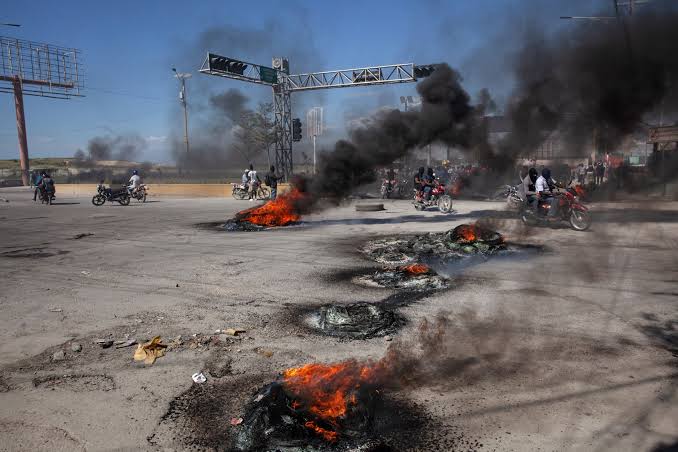
Wails of grief swept through the hills above Haiti’s capital on Monday as families searched desperately for missing relatives after heavily armed gang members stormed the farming community of Kenscoff, killing dozens of residents and setting homes ablaze in another devastating escalation of the country’s security crisis.
The attack began late Sunday when armed men invaded the once relatively peaceful community overlooking Port-au-Prince, opening fire and burning houses as frightened residents fled into the night.
Kenscoff Mayor Jean Massillon initially said communication failures and difficulties accessing some affected communities made it impossible to determine the full scale of the killings.
But the United Nations subsequently put the toll at at least 47 people killed and 22 injured in the overnight assault, making it one of the deadliest recent attacks in an area that has repeatedly come under pressure from armed groups.
For residents, however, the figures hardly capture the anguish left behind.
Robert Jean said he was at home when gunfire suddenly erupted, forcing him to wake those around him and flee.
“When I heard the shooting, I was at home and told people, ‘Wake up. I am hearing the shooting. We need to move quickly,’” he recalled.
The group managed to reach a safer area, but when Jean began checking whether everyone had escaped, his brother, Jean Mercidieu, was nowhere to be found.
“I called his phone and could not get a hold of him,” he said.
Across Kenscoff, similar stories emerged as survivors returned to devastated neighbourhoods, searching among burned buildings and abandoned streets for relatives who had disappeared during the assault.
The mayor blamed the attack on members of Viv Ansanm, the powerful coalition of armed gangs that has repeatedly targeted Kenscoff and other communities around Port-au-Prince.
The United States designated Viv Ansanm a foreign terrorist organisation in 2025. The coalition has expanded its reach as Haiti’s security institutions struggle to contain heavily armed groups controlling critical roads, neighbourhoods and economic routes.
The latest violence has intensified public anger over what residents describe as inadequate police protection.
Enold Saint Verti, a farmer in the area, said stronger security deployment could have prevented the bloodshed.
“We don’t have good police. If only we had good police, they would have placed an armed truck here and what happened here would have been prevented,” he said.
The frustration reflects a wider crisis confronting Haiti, where gangs are estimated to control about 70 per cent of Port-au-Prince and have increasingly pushed operations beyond traditional strongholds.
Around 1.5 million people have been displaced by violence across the country, while more than 3,100 people were killed and another 1,189 injured between January and June 2026, according to United Nations figures.
Kenscoff has become particularly vulnerable because of its strategic position in the hills overlooking key routes into Pétion-Ville, an area containing embassies, hotels and the temporary seat of Haiti’s government.
The community has suffered repeated attacks since early 2025 involving killings, kidnappings, arson and other violence.
Following the latest assault, Haiti’s government condemned what it called a “heinous attack” and said security reinforcements were being deployed to the area.
Authorities pledged that Kenscoff would not be abandoned and that state control would be restored, but residents who have endured repeated attacks are demanding more than assurances.
The massacre comes at an especially dangerous moment for Haiti as the Caribbean nation attempts to organise its first general elections in more than a decade.
The first round is scheduled for December 13, 2026, and voter registration efforts are already under way. However, international officials and election observers have repeatedly warned that deteriorating security could undermine preparations and make credible nationwide voting extremely difficult.
Haiti has been without an elected president since Jovenel Moïse was assassinated in July 2021, while political instability, gang expansion and the weakening of state institutions have deepened the humanitarian emergency.
The renewed bloodshed in Kenscoff now raises another troubling question over whether authorities can secure communities sufficiently for millions of Haitians to participate safely in December’s vote.
But for families walking through the ruins of their neighbourhoods, elections remain distant.
Their immediate struggle is far more basic: finding the missing, burying the dead and determining whether the homes they fled can ever again be considered safe.
As Haiti prepares to ask its citizens to return to the ballot box, the charred houses and grieving families of Kenscoff offer a grim reminder that restoring democracy will depend first on restoring something many communities have almost completely lost — security.