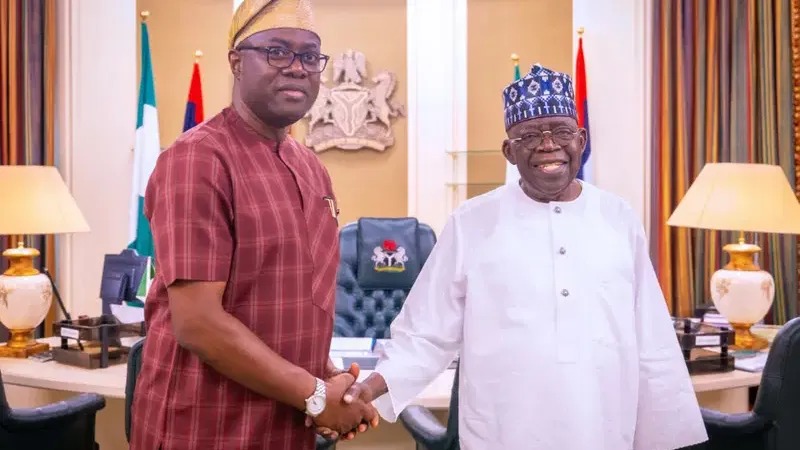
The battle for control of Nigeria’s opposition ahead of the 2027 presidential election intensified on Monday as the Allied Peoples Movement, APM, threw its weight behind Oyo State Governor Seyi Makinde, declaring him the strongest candidate to lead a united challenge against President Bola Tinubu.
The endorsement comes barely a week before a crucial summit of opposition parties scheduled for Monday, August 31, 2026, in Abuja, where political leaders are expected to confront perhaps their biggest challenge yet — whether competing presidential ambitions can be sacrificed for a single candidate capable of taking on the ruling All Progressives Congress, APC.
APM National Publicity Secretary, Abubakar Yusuf, who addressed journalists in Abuja, said consultations among opposition parties had reached an advanced stage, but argued that Makinde stood out among those being considered for the potentially decisive 2027 contest.
“I can confirm to you that discussions and consultations among opposition parties are going on well and reaching an advanced stage on the issue of a single presidential candidate,” Yusuf said.
“Without prejudice to the outcome of the consultations, Governor Makinde comes clearer as the best opposition consensus presidential candidate.”
His declaration introduces another powerful name into an already complicated opposition equation dominated by former Vice President Atiku Abubakar and former Anambra State Governor Peter Obi.
The G-100, which is spearheading the opposition unity initiative, has warned that a fragmented field could weaken the chances of defeating Tinubu and the APC. The August 31 summit is intended to bring participating opposition parties together to discuss the structure and terms of a broader alliance.
But the search for consensus is already encountering the formidable obstacle of personal presidential ambitions.
There are indications that the camps of Atiku, associated with the African Democratic Congress, ADC, and Obi of the Nigeria Democratic Congress, NDC, are reluctant to surrender their respective presidential aspirations, setting the stage for potentially difficult negotiations over who should carry the opposition banner.
Yusuf acknowledged the sensitivity of the discussions but maintained that defeating the ruling party should take precedence over individual political calculations.
“It is a delicate issue that touches on interests. But most importantly, we, especially in the APM, are listening to Nigerians,” he said.
“What Nigerians want is for opposition parties to come together, form a strong front and defeat President Tinubu in the 2027 elections.”
Beyond electability, the APM spokesman introduced another politically sensitive factor into the emerging negotiations — the argument that the South should retain the presidency in 2027.
According to Yusuf, some political stakeholders believe Tinubu’s successor should come from the South and serve another four years before power potentially rotates to the North.
That calculation could prove significant in discussions surrounding Atiku, Obi, Makinde and other possible contenders as opposition parties attempt to balance electoral strength, regional sentiment and internal party interests.
“Also, don’t overlook the fact that Makinde is from the South, that is having regard to the sentiment that the South should be allowed to replace President Tinubu to complete the remaining four-year tenure after which power will go to the North,” Yusuf said.
He, however, rejected suggestions that regional rotation was the sole basis for the APM’s preference for the Oyo governor.
The party spokesman cited Makinde’s record in government and what he described as his appeal among young Nigerians, professionals and other segments of the electorate as reasons the governor could mount a formidable challenge to Tinubu.
“Go across the country and ask questions. You will notice that Nigerians want a new beginning,” Yusuf said.
“They want a leader with new and practical ideas, not theories and finger-pointing; a leader with answers and solutions, and Governor Makinde fits into the frame.”
Yusuf further claimed that Makinde possessed a practical blueprint for addressing insecurity, unemployment, economic difficulties and Nigeria’s infrastructure deficit.
“He is the only candidate with the blueprint to secure the nation, revamp the economy, create new jobs and revitalise our comatose infrastructure,” he said.
The claim represents the APM’s assessment of the governor and is likely to be contested by supporters of other presidential hopefuls as negotiations progress.
Asked whether the apparent reluctance of the Atiku and Obi camps to embrace a consensus candidate was driven by regional considerations or their individual ambitions, Yusuf declined to speculate.
“I cannot speak for them,” he said.
“What is important now is for all stakeholders to set aside their personal interests and support Governor Makinde, who we insist is best positioned to defeat President Tinubu at the election.”
The search for a consensus opposition candidate has become one of the defining political issues ahead of the 2027 presidential contest, with several opposition figures and groups arguing that only a united platform can mount a formidable challenge against the APC.
For the opposition, however, agreeing that unity is necessary may prove considerably easier than deciding who should lead the alliance.
Makinde’s emergence as the APM’s preferred candidate adds another dimension to a field already crowded with established political heavyweights, while questions over zoning, party structures, running mates and control of a possible coalition machinery remain unresolved.
With Tinubu expected to seek another term, the August 31 summit could therefore become an early defining moment in the 2027 presidential race.
The opposition must now decide whether its leading figures can trade personal ambition for collective strategy or enter another presidential election divided against an incumbent commanding the machinery of the ruling party.