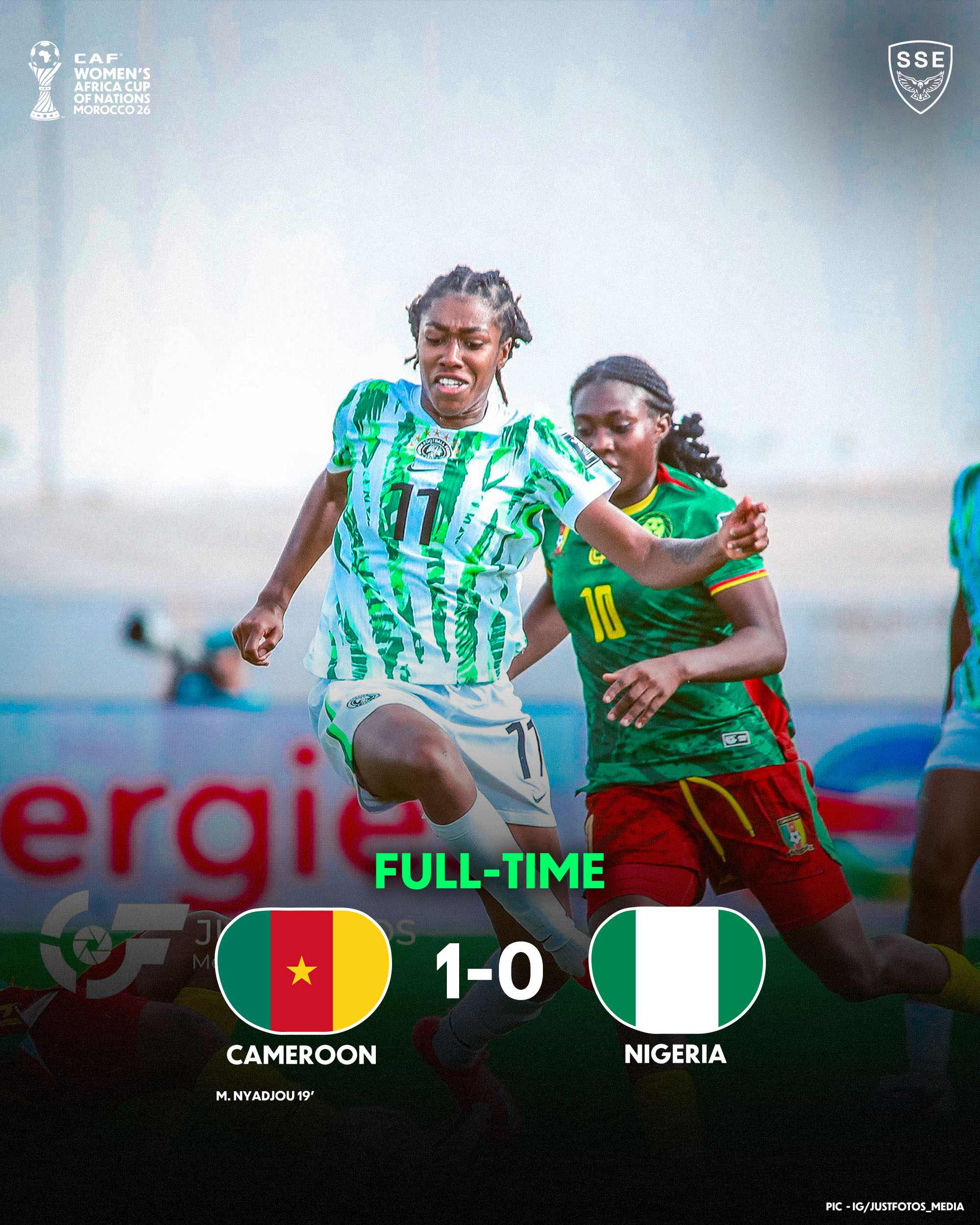
Nigeria’s hopes of securing a place at the 2027 FIFA Women’s World Cup have suffered a major setback after the Super Falcons were eliminated from the Women’s Africa Cup of Nations following a shock 1-0 quarter-final defeat to Cameroon.
The painful exit at the Larbi Zaouli Stadium on Sunday ended Nigeria’s reign as African champions and denied the ten-time continental champions an automatic ticket to the global showpiece in Brazil.
The setback has revived concerns over Nigeria’s increasingly precarious World Cup qualification fortunes across both the men’s and women’s national teams.
While the Super Eagles have in recent years endured their own struggles to secure a place at major international tournaments, the Super Falcons now face a similar battle, with their direct route to the 2027 Women’s World Cup gone and qualification left to the playoff route.
Cameroon delivered the decisive blow in the 20th minute when forward Myriam Nyadjou found the net with the only goal of a fiercely contested encounter.
Nigeria, despite dominating possession at various stages, struggled to translate pressure into clear-cut opportunities.
Captain Rasheedat Ajibade attempted to drive the Falcons forward and unlock the Cameroonian defence, but Nigeria was largely restricted to long-range efforts as Cameroon maintained a disciplined defensive shape.
The Super Falcons intensified their attacking pressure after the break, but Cameroon’s backline remained resolute, frustrating Nigeria’s attempts to force an equaliser.
Even during the frantic closing stages and added time, Nigeria could not find the breakthrough needed to keep their title defence alive.
The defeat represents a major blow for a Nigerian side that entered the tournament as defending champions and among the favourites to lift the trophy again.
For Cameroon, however, the victory was historic.
The Indomitable Lionesses secured their first knockout-stage victory over Nigeria at the WAFCON since the 2012 third-place play-off and advanced to the semi-finals.
More significantly, their progression guarantees Cameroon a top-four finish and an automatic place at the 2027 FIFA Women’s World Cup.
Nigeria, in contrast, must now navigate the playoff tournament if they are to avoid another painful World Cup absence.
The development carries an uncomfortable resemblance to the predicament confronting the Super Eagles, whose own qualification campaign for the men’s World Cup has been marked by setbacks and uncertainty.
For Nigerian football, the warning signs are becoming difficult to ignore: a nation accustomed to appearing on football’s biggest stage is increasingly being forced to fight through difficult qualification routes rather than securing its place early.
The Super Falcons’ latest setback therefore goes beyond the loss of a continental title. It has put Nigeria’s World Cup dream under immediate pressure and raised fresh questions about the country’s ability to maintain its traditional dominance in African football.
With the automatic ticket now gone, the Falcons must regroup quickly, as their next assignment could determine whether Nigeria maintains its proud record of participation at the Women’s World Cup—or faces another painful absence from the global stage.