- Your Policies Pushed Millions More Nigerians Deeper Into Poverty, Hunger
- Acute Food Insecurity Has Deteriorated Since You Assumed Office
- I Would Have Gone Into The Forest To Lead Oyo Rescue Myself
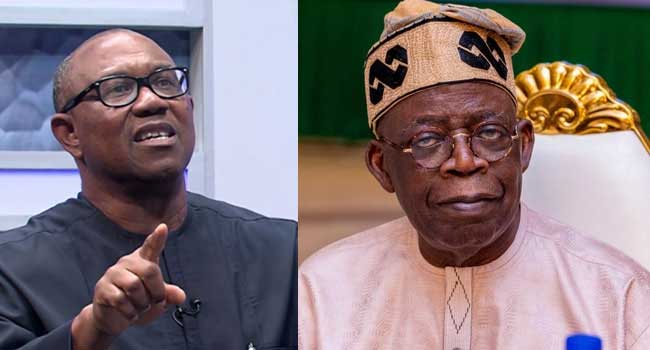
The presidential candidate of the Nigeria Democratic Congress (NDC), Peter Obi, has criticised President Bola Tinubu over his recent remarks on hunger, describing the comments as insensitive to the plight of millions of Nigerians battling worsening economic hardship.
In a statement posted on Friday titled “Hunger and the Insensitivity of Mr. President,” Obi reacted to Tinubu’s remarks made during a meeting with Catholic bishops, where the President reportedly said hunger had always existed in Nigeria, even before he was born.
Obi acknowledged that hunger has been a longstanding challenge in Nigeria but argued that such a statement failed to reflect the gravity of the country’s current economic reality.
According to him, available data show that acute food insecurity has deteriorated significantly since the Tinubu administration assumed office in 2023.
He claimed that while an estimated 17 million Nigerians were facing acute food insecurity before the current administration took office, the figure has now risen to about 35 million, attributing the worsening situation to persistent economic and security challenges.
The former Anambra State governor also expressed concern over rising poverty levels, alleging that the number of Nigerians living in extreme poverty had increased from about 87 million in 2023 to nearly 140 million, making Nigeria home to the world’s largest population of people living in extreme poverty.
Obi acknowledged that the Tinubu administration inherited serious challenges but insisted that governments should be judged by their ability to deliver results rather than the problems they inherited.
“The government must honestly acknowledge that its response has fallen far short of what the situation demanded, with millions more Nigerians pushed deeper into poverty and hunger,” he said.
He blamed the worsening hardship on what he described as persistent insecurity, poor economic management, fiscal indiscipline, wasteful public spending and inadequate investment in productive sectors of the economy.
Obi urged the Federal Government to prioritise investments in education, healthcare, agriculture, security and small businesses, while implementing policies capable of creating jobs, boosting production and lifting Nigerians out of poverty.
The former Anambra governor and Nigeria Democratic Congress presidential aspirant said that, had he been President, he would have walked into the forest himself to free the pupils and teachers snatched in Oriire, Oyo State. Every hostage would have come out, he insisted — even if it cost lives.
“Days of kidnap of Oyo children. The President did not call the governor. What do you mean? Fifty days,” he said.
“But I’ll be there in two days. Is the bush not in Nigeria? That bush they went in. The bush is in Nigeria.”
Then the line that will travel: “Everybody in that bush will come out. Everybody. There might be casualties but everybody will come out.”
He was speaking on State of the Nation with Peter Obi, aired live on Afia TV’s Eastern Eye and hosted by Alex Ogbodo.
The maths behind his anger is hard to ignore. The Oriire victims — dozens of schoolchildren and their teachers — were taken on May 15 and spent roughly 56 days in the bush before security forces pulled them out in July. To Obi, that stretch of time was itself the scandal. Real leadership, he argued, doesn’t sit on its hands for weeks while parents wait by the phone.
His sharpest jab was aimed squarely at President Bola Tinubu, who he claimed never once called Oyo Governor Seyi Makinde across the entire ordeal. For Obi, that wasn’t a slip. It was the whole problem in miniature.
He didn’t stop at Oyo. Nigeria’s habit of wrapping security operations in secrecy drew his contempt too, and he wanted results made public.
“We arrest some people. Parade the people. Let people see them. What is happening?” he said. “When America or other countries kill people like that, they parade them. They show it. Everybody sees it. In Nigeria, everything is shrouded in secrecy.”
Then came the part he clearly relishes — his own record. Back in Anambra, Obi recalled, he went after the criminal gangs nesting in the state’s forests directly, but not before clearing it with then-President Olusegun Obasanjo. He told Obasanjo a certain forest had become a threat, and that the men hiding there had to go. Several notorious criminals, he said, were killed in those operations while he was governor.
It all folds into one belief he keeps returning to — that command means owning the risk, fully.
“No way. It’s either I’m in charge or you people are in charge. I go home. One person must be in charge,” he said. “And if you’re in charge, if you want to lead, you should be ready to die. If you don’t want to, you go home. One must be in charge.”
The timing is no accident. Insecurity is again dominating the national mood, and presidential ambitions are stirring beneath the surface. By casting himself as the leader willing to put his own neck on the line, Obi is drawing the same contrast he has drawn before — nerve and hands-on grit against what he paints as a distant, cautious administration. Supporters will hear courage. Critics will ask whether any sitting President should be storming a kidnappers’ camp at all.
Either way, the words will land. And in a country where the forests too often make their own rules, Obi has once again dared to say out loud what a lot of frustrated Nigerians have been muttering for months.