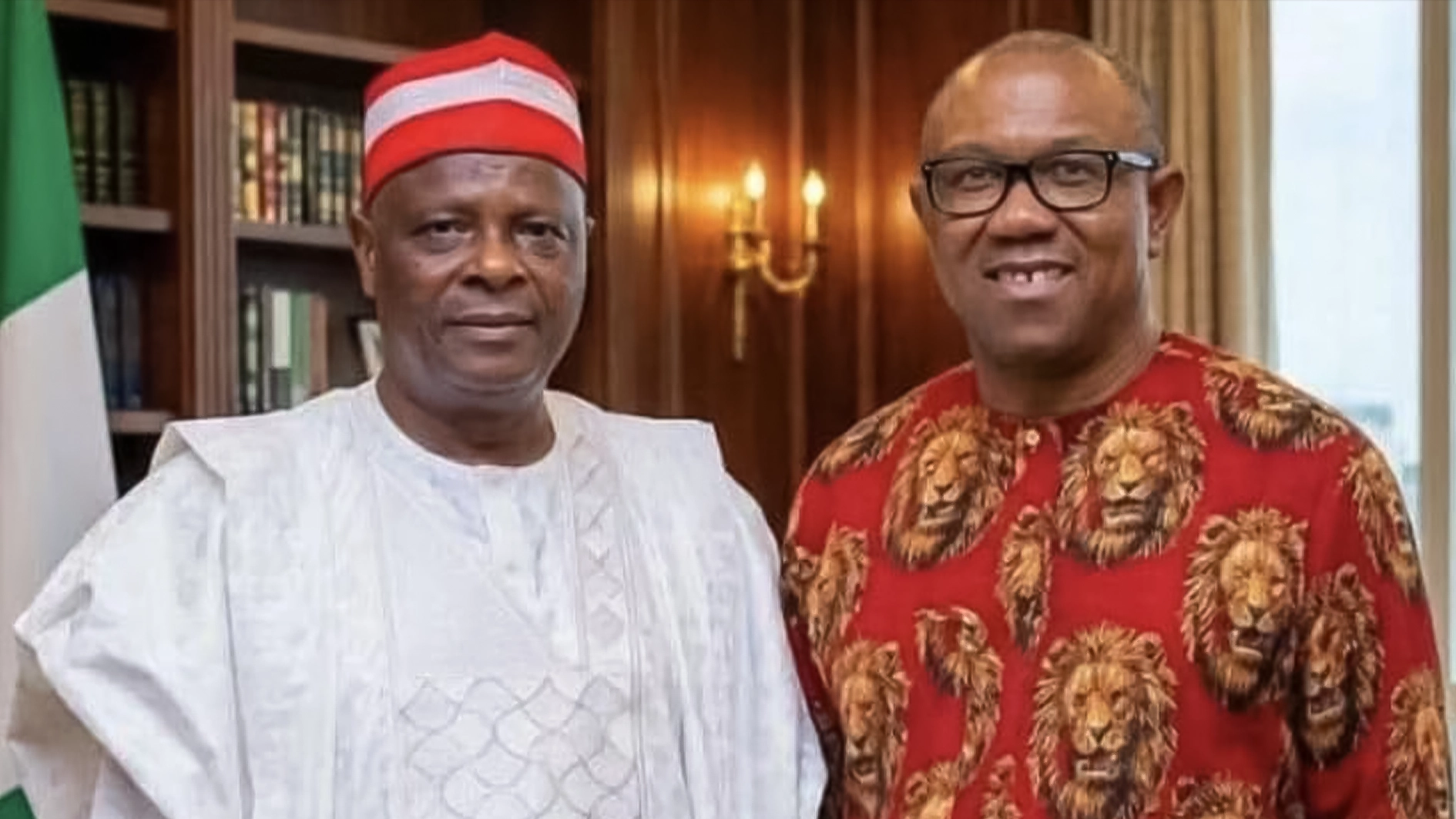
The controversy, which erupted after Obi’s running mate, Senator Rabiu Musa Kwankwaso, publicly confirmed the existence of the pact, has drawn sharply contrasting reactions from influential northern socio-cultural organisations and senior legal practitioners, with critics dismissing the arrangement as unconstitutional while supporters describe it as a practical step towards sustaining regional balance in the country’s leadership.
Kwankwaso, a former governor of Kano State, disclosed during an interview on Channels Television that Obi voluntarily signed a written commitment to relinquish office after one term if elected, allowing power to return to the North in line with the party’s internal power-sharing understanding.
Expressing confidence in Obi’s integrity, Kwankwaso said he had no reason to doubt that the former Anambra State governor would honour the agreement.
“Oh yes, I personally believe him. I don’t think, based on what I now know about him, that he will change his mind when the time comes. We are all gentlemen,” Kwankwaso said.
However, the disclosure has triggered strong opposition from the Arewa Consultative Forum (ACF), which described the arrangement as unconstitutional, politically unproductive and incapable of guaranteeing northern support for the NDC ticket.
The apex northern socio-cultural organisation argued that neither Obi nor Kwankwaso possesses the mandate to negotiate the presidency on behalf of any section of the country.
Speaking on the development, the ACF’s National Publicity Secretary, Prof. Tukur Muhammad Baba, maintained that the reported agreement lacks constitutional foundation and cannot override the provisions of the 1999 Constitution.
According to him, Nigeria’s Constitution provides for a renewable four-year tenure, making any private political understanding on limiting presidential tenure legally unenforceable.
He further argued that if Obi were elected and delivered strong leadership, there would be no justification for denying Nigerians the opportunity to re-elect him for a second term.
The ACF also described the alleged pact as evidence of political desperation rather than a genuine commitment to national service, insisting that leadership should be driven by competence, equity and patriotism rather than pre-arranged succession deals.
The forum contended that the agreement should not only fail to attract northern support but should equally serve as grounds for voters to reject both Obi and Kwankwaso at the 2027 presidential election.
Offering a contrasting perspective, the Middle Belt Forum (MBF) endorsed the reported one-term commitment, describing it as consistent with the principle of power rotation that has shaped Nigeria’s political landscape since the return to democratic rule.
The forum’s spokesman, Mr. Luka Binniyat, said the arrangement would be acceptable provided it paves the way for the presidency to return to the Middle Belt in 2031.
According to him, while power should shift back to the North after 2031, the region’s next opportunity should belong to the Middle Belt rather than the core North.
The MBF maintained that the Middle Belt has waited long enough to produce Nigeria’s president and expressed the hope that major political parties would, when the time comes, support a presidential candidate from the region.
Beyond the political debate, legal experts have also questioned the validity of the reported agreement, insisting that no private arrangement can supersede constitutional provisions governing presidential tenure.
Senior Advocate of Nigeria, Abdul Balogun, said the Constitution recognises only a four-year renewable tenure of two terms and does not provide for any legally enforceable one-term agreement between political actors.
He maintained that any such understanding remains purely voluntary and can be abandoned without legal consequences.
Another legal practitioner, Hillary Omoh, also argued that agreements become enforceable only when backed by law, stressing that the Constitution gives every eligible Nigerian president the right to seek re-election for a second term if he so desires.
She noted that while a president may voluntarily decline to contest another election after one term, no private political agreement can legally compel such a decision.
Similarly, lawyer James Ekwe described the arrangement as a moral rather than legal obligation.
He observed that although political actors may enter into gentlemen’s agreements before assuming office, the realities and privileges associated with high political office often alter such commitments, making them difficult to sustain over time.
The unfolding controversy has once again brought the issue of zoning and power rotation to the forefront of national discourse, highlighting the delicate political calculations already shaping alignments ahead of the 2027 presidential election.
With influential regional groups sharply divided and constitutional experts questioning the legal weight of the reported pact, the debate is expected to remain a defining issue as political parties intensify consultations and coalition-building in the countdown to Nigeria’s next presidential contest.