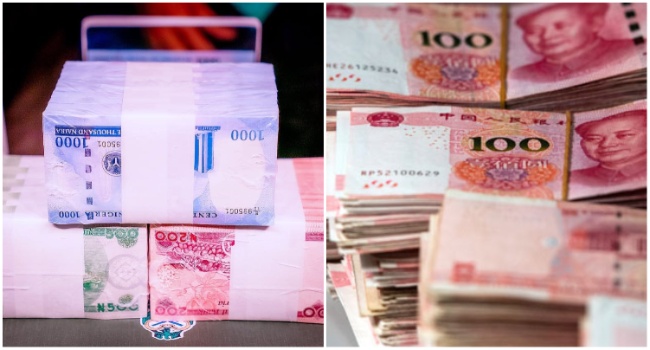
Nigeria and China have renewed their 15 billion Yuan (about $2.09 billion) Bilateral Currency Swap Agreement (BCSA), designed to boost trade and investment between the two countries.
In a statement on Friday, the People’s Bank of China (PBOC) confirmed that the new facility aims to enhance financial cooperation and broaden the use of both currencies.
“The agreement is valid for three years and can be renewed upon mutual consent,” Bloomberg quoted the bank as saying.
This deal will enable seamless direct exchange between the Chinese yuan and the Nigerian naira, offering an alternative to reliance on the US dollar and helping to reduce transaction costs in trade between the two countries.
READ ALSO: Niger State, China Partner To Boost Agricultural Productivity
The Matrix reports in its bid to curb local demand for the dollar, the Central Bank of Nigeria (CBN), on April 27, 2018 signed the BCSA with the People’s Bank of China (PBoC).
The agreement, which commenced in July 2018, expired in April 2021 and was subsequently renewed for another three year term.
At the time of the agreement, it allowed for the exchange of up to 15 billion Chinese yuan (CNY) for 720 billion Nigerian naira (NGN), roughly equivalent to $2.5 billion at an exchange rate of NGN305 to $1.
The primary objective of the swap is to streamline trade transactions by eliminating the need for US dollars as an intermediary currency.
READ ALSO: Trade Between Nigeria, China One Of Highest In Africa, Hits $22.6bn- Shettima
This deal ensures liquidity in naira for Chinese businesses operating in Nigeria and in yuan for Nigerian companies engaged in trade with China. It aims to facilitate smooth transactions, support bilateral investments, and improve market efficiency. Additionally, the arrangement will assist both countries in managing their foreign exchange reserves, bolster financial stability, and promote greater economic cooperation.
Through this agreement, the central banks of both nations can inject liquidity into their financial systems via bi-weekly auctions.