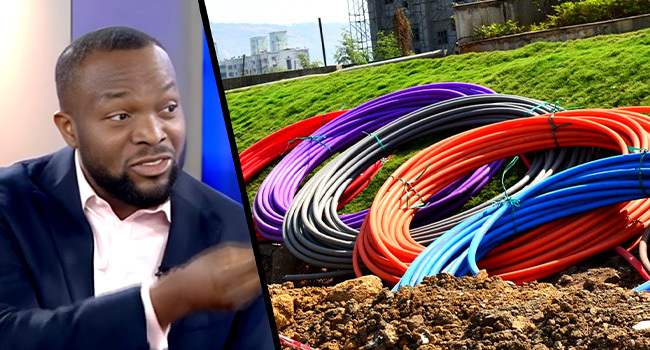
In response to deter the recurrence of disruption critical telecom services occasioned undersea cable cut, that affected Nigeria,Ghana ,Togo,Senegal among others,the Minister of Communications and Digital Economy, Bosun Tijani, has announced plans to spearhead a global collaboration aimed at enhancing the protection of undersea cables.
Bosun Tijani made this disclosure on social media platform, X (formerly Twitter) on Sunday.
Recognising the critical role these cables play in the digital economy, Tijani emphasised the need to review international laws and foster partnerships with regional and global bodies to accelerate efforts to safeguard this vital infrastructure.
Assuring those affected by the disruptions, Tijani stated that the Nigerian Communications Commission was actively working with all relevant stakeholders to swiftly resolve the issues at hand.
According to him, the initiative marks a significant step towards ensuring the resilience and reliability of undersea cables, crucial lifelines in today’s interconnected world.
Tijani said, “I must commend the selflessness shown by the leadership of @GloWorld @WIOCC_ @MTNNG @Mainoneservice and the entire sector in coming together to limit the impact of the cuts. Your actions are helping us all to better prepare for the future.
“This is also an opportunity for us to review international laws and collaborations to adequately protect undersea cables, and I will be engaging regional and global bodies to accelerate efforts on this crucial agenda.
“To those experiencing disruption, please rest assured that @NgComCommission is working with all key stakeholders to resolve the matter in the shortest possible time.”
On Thursday, disruptions to the undersea cable providing broadband Internet connectivity to Nigeria and neighboring countries in the West African sub-region prompted numerous banks, financial institutions, telecom companies, and related businesses to reduce their operations. The cable companies, including the West African Cable System and African Coast to Europe in the West Coast route from Europe, experienced faults, while SAT3 and MainOne faced downtime.
Sarafadeen Fasasi, President of the Association of Mobile Money and Bank Agents in Nigeria, expressed concerns about the disruption in internet service, highlighting significant reconciliation issues for his members. Fasasi emphasized the crucial role of technology and internet connectivity in financial services, noting that the breach had affected numerous transactions. He explained that many bank transfers failed to go through for customers, resulting in debits to agents’ accounts and ensuing issues with customers. Fasasi described the situation as a serious headache in recent days, acknowledging slight improvement but noting persistent reconciliation challenges.
Reports indicate that the undersea cable cuts may persist for several weeks, affecting eight West African countries along with users in South Africa due to damage to four sub-sea cables. The cause of the cable cutting remains unknown, although a shifting seabed is among the potential reasons.
The National Communications Authority in Ghana disclosed that resolving the internet challenge would likely take a minimum of five weeks. Following a meeting involving all subsea cable landing service providers and affected mobile operators, the NCA released an official statement outlining an estimated timeframe for full service restoration.
In the statement, the NCA acknowledged the disruptions’ impact on economic, academic, and social activities, pledging continued collaboration with relevant stakeholders to address the issue. Meanwhile, services in Cote d’Ivoire, one of the affected countries, have been restored, according to Charles Jama, a public relations expert in the French-speaking nation.