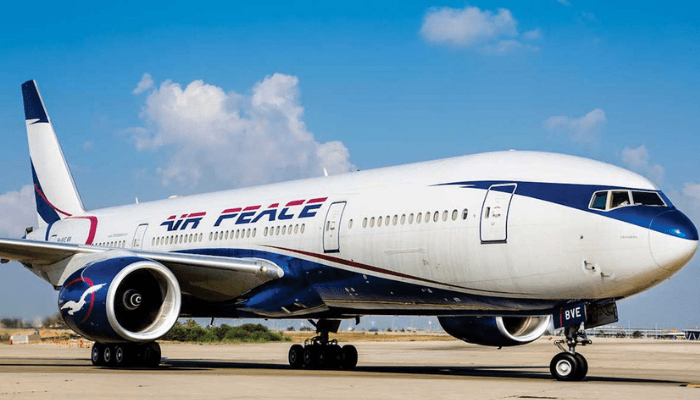
Air Peace has launched a blistering challenge to the Nigeria Civil Aviation Authority (NCAA) over its August 2026 flight disruption report, accusing the regulator of using inaccurate operational data and unfairly portraying the airline as primarily responsible for flight delays.
The airline, in a statement signed by its Chief Operating Officer, Oluwatoyin Olajide, said the NCAA report contained “fundamental data inaccuracies” concerning its flight volume and failed to properly distinguish between delays caused by the airline and those triggered by external factors.
Air Peace claimed it operated 2,564 flights in August 2026, sharply above the 1,864 flights reportedly captured in the NCAA’s data.
According to the airline, the omission of more than 700 flights from the regulator’s data pool distorted its performance metrics and inflated the reported percentage of delayed flights.
Air Peace also questioned the timing and methodology of the NCAA report, asking why the regulator’s monthly series began with August rather than July, following the publication of first and second-quarter aviation data on July 31.
“It is indeed worrisome that there is still no equivalent monthly data located for July, yet the NCAA published unusually granular August airline delay data only 13 days after month-end,” the airline said.
The carrier further accused the regulator of releasing the August figures without adequately accounting for what it described as an “extraordinary aviation-sector industrial disruption” triggered by aviation unions on August 11.
It said the union action disrupted its operations for more than 14 days, causing rescheduling, cancellations and consequential delays across its network.
Air Peace: Only 15% Of Delays Were Internal
At the heart of Air Peace’s rebuttal is its claim that the overwhelming majority of delays recorded during the month were caused by factors outside its control.
The airline said its internal review showed that 391 flights, representing about 15 per cent of the delays experienced in August, were attributable to internal factors.
It identified unscheduled aircraft maintenance arising from technical issues and fuel-related challenges as the major internal causes.
The remaining disruptions, it said, were linked to external factors, including airport congestion, bird strikes, airport infrastructure failures, adverse weather, industrial action and damage to its aircraft by a ground-handling company.
According to Air Peace, airport congestion and traffic accounted for more than 51 per cent of its external delays, with aircraft frequently held on the ground or placed in holding patterns because of infrastructure and capacity constraints.
The airline also cited bird strikes as another major disruption, revealing that one of its aircraft, 5N-BYG, was struck by a bird in Abuja.
Air Peace said the incident damaged the aircraft’s inlet cowl beyond acceptable limits and required repairs costing about $1.8 million.
The aircraft, which the airline said normally operates at least eight sectors daily and carries about 1,000 passengers, was subsequently grounded for more than a week while the damaged inlet cowl was replaced.
‘How Is Consequential Delay Air Peace’s Fault?’
Air Peace also blamed airport facility deficiencies and breakdowns, saying they frequently disrupted boarding and departure schedules.
On weather-related disruptions, the airline said adverse conditions during the rainy season forced safety holds and diversions, with a single diversion potentially resulting in nearly three hours of consequential delays.
“One flight diversion could result in almost three hours’ delay. How is the consequential delay Air Peace’s fault?” the airline asked.
It said it continued to cater to affected passengers, including providing hotel accommodation in some cases, even when disruptions were caused by circumstances outside its control.
The carrier also cited the unprecedented picketing of its operations by aviation unions and damage to one of its aircraft by a ground-handling company, which it said kept the aircraft out of service for more than 14 days.
“Again, the narrative that Air Peace is primarily responsible for these delays is completely false,” the airline declared.
“The majority of the delays experienced by our passengers were driven by external factors and completely outside of our control.”
Air Peace said it had previously refrained from publicly challenging the figures but was now compelled to release its own account of events.
“We have restrained ourselves from making these facts public before now, but we have now been pushed beyond acceptable limits, hence the need to go public and state the facts the way they are,” it said.
The airline stressed that it had continued to invest in fleet expansion, crew availability, training and aircraft maintenance while pursuing improvements in on-time performance and passenger satisfaction.
However, it maintained that airlines could not safely or logistically eliminate delays arising from airport congestion, inadequate infrastructure, sunset restrictions and adverse weather.
Air Peace urged the NCAA to review and audit its data collection methodology, particularly the classification of delay causes, to ensure future reports accurately capture airline performance within the broader operating environment of Nigeria’s aviation sector.
FG Opens Fresh Push To Review 1978 BASA, 2015 Saudi Aviation Pact
The Federal Government has launched a fresh diplomatic and aviation strategy aimed at securing a larger share of Nigeria’s Hajj pilgrim airlift operations for the country’s indigenous airlines.
The Minister of Aviation and Aerospace Development, Festus Keyamo, disclosed this in a post on Thursday, saying he convened a high-level meeting following a directive from Vice-President Kashim Shettima on preparations for the forthcoming Hajj operation.
The meeting brought together key aviation and Hajj stakeholders, including the Permanent Secretary in the ministry, Mahmud Adamu Kambari; Chairman of the National Hajj Commission of Nigeria (NAHCON), Ambassador Ismail Abba Yusuf; Managing Director of the Federal Airports Authority of Nigeria (FAAN), Mrs Olubunmi Kuku; and operators of Hajj airlines.
Keyamo said the meeting focused on Nigeria’s Hajj aviation strategy, particularly efforts to increase the number of pilgrims that could be airlifted by Nigerian flag carriers.
According to him, the government is determined to ensure that Nigerian pilgrims receive fair and respectful treatment throughout the airlift operation.
“We discussed ways by which we can negotiate more quota of pilgrims to be airlifted by our flag carriers for Hajj operations whilst ensuring Nigerian pilgrims are treated with the fairness and respect they deserve,” Keyamo said.
The minister said the government had consequently constituted a joint technical team to review two key bilateral aviation agreements—the 1978 Bilateral Air Services Agreement (BASA) and the 2015 Memorandum of Understanding (MOU).
He said the review would provide the basis for fresh diplomatic engagement with the Saudi Arabian authorities over Nigeria’s aviation interests in Hajj operations.
FG Targets Aviation Leverage
The move signals an attempt by the Federal Government to place Nigeria’s flag carriers at the centre of the lucrative and strategically important Hajj airlift market, while using existing bilateral aviation agreements as a framework for negotiations with Saudi Arabia.
Keyamo said the technical review would enable Nigeria to engage the Saudi authorities diplomatically on the country’s demands.
The development comes as government agencies and airline operators begin preparations for the forthcoming Hajj operation, with the treatment, airlift and welfare of Nigerian pilgrims remaining major issues in the annual exercise.
The minister’s intervention also brings the aviation ministry, NAHCON, FAAN and Hajj airline operators into a coordinated framework as the government seeks to strengthen Nigeria’s negotiating position ahead of the next pilgrimage operation.