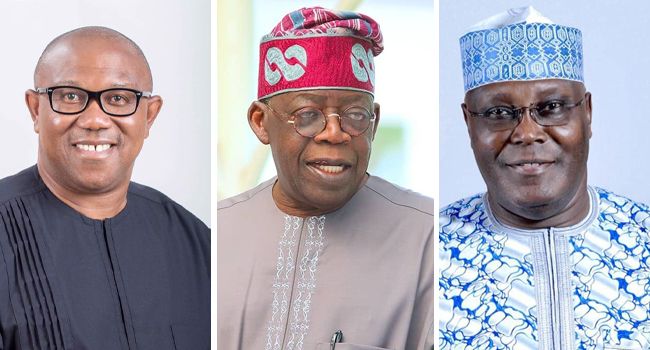
- Obi Counters Atiku Over Subsidy, Says Mismanagement Of Proceeds Not Reason To Reverse Removal
- Sowore, Amaechi Trade Tackles At NBA Conference Over Governance Record
- APM Tells Atiku, Obi To Shelve Ambitions For Makinde
Nigeria’s opposition front is again showing deep cracks as the explosive debate over fuel subsidy threatens to widen the political gulf between the leading presidential contenders ahead of the 2027 election.
The latest fault line was triggered by former Vice President and African Democratic Congress (ADC) presidential candidate, Atiku Abubakar, who has thrown his weight behind a return to petrol subsidy if elected, arguing that Nigerians have not seen sufficient benefits from its removal.
Atiku’s position has immediately drawn fierce criticism from the Presidency and sections of the organised private sector, which have described subsidy restoration as a dangerous reversal of the economic reforms introduced by President Bola Tinubu.
The controversy is particularly damaging for the opposition because the leading challengers to Tinubu are no longer singing from the same hymn sheet on one of the most politically explosive economic issues in the country.
The presidential candidate of the Nigeria Democratic Congress (NDC), Peter Obi, has taken a markedly different position from Atiku.
Obi has consistently argued that subsidy removal was necessary, but that the Tinubu administration implemented it in a haphazard manner without adequately protecting Nigerians or channeling the savings into productive sectors. In 2025, he said he would also have removed the subsidy and floated the naira, but in a more organised and productive manner.
“Well, I subscribe, and I maintain that you need to remove subsidy. Mismanagement of the proceeds should not be the reason for not removing it,” he said at the event in Port Harcourt, Rivers State.
“What we should have done is that when we remove subsidy, we would have given the people an alternative usage for the subsidy. What we have today is that that removal and attendant resources being recovered are also being mismanaged and stolen.”
According to Obi, proceeds from subsidy removal should be ploughed back into areas such as healthcare.
“For example, we have received, according to them [the Federal Government], N16 trillion. I said it before; go to my manifesto and see where I said I would remove subsidy.
“We’ll do it in an organized manner, and whatever we recover will be invested appropriately, and I’ll just give you an example because we have no time.”
“So it’s what you use the money for that is the problem,” the former Anambra State governor told the gathering in the coastal state.
“We will use the money in an organised manner, or you save it. If they had saved the money and decided to do like any other country, we would have had $10 billion added to the sovereign wealth fund, which, if you add it today, will be getting about $10 billion every month, which we can use for a purpose.”
As if that was not enough, a fiery political showdown erupted at the Nigerian Bar Association (NBA) conference in Port Harcourt on Monday as former Rivers State governor and African Democratic Congress (ADC) vice-presidential candidate, Chibuike Amaechi, traded heated words with African Action Congress (AAC) presidential candidate, Omoyele Sowore.
The verbal brawl erupted after Sowore launched a blistering attack on Nigeria’s political establishment, accusing former office holders of contributing to the economic crisis now confronting the country.
Sowore urged Nigerians to reject politicians who, after holding power and allegedly failing to deliver, return to seek another mandate.
“Please, please, don’t let these politicians lie to you,” Sowore told the audience.
Turning his fire on Amaechi, who was seated at the conference, Sowore referenced an earlier comment by the former governor and minister.
“I loved one thing that Amaechi said. He said, apart from Sowore and Abiola, the rest of us that have been in government have failed. They have no business coming back,” he said.
Sowore then went straight for Amaechi’s record as Rivers governor and transportation minister, particularly his handling of infrastructure, education and transportation.
“When it comes to subsidy, transportation policy is important. We have a former governor of Rivers State here, Amaechi, who built a rail line that went nowhere,” Sowore declared.
He argued that Nigerians should not be persuaded by politicians who failed to adequately support citizens while in office.
“And we can’t ignore that those of you who had governed before refused to subsidise your people,” he said.
Sowore also accused Amaechi’s administration of failing to adequately fund education in Rivers State, claiming lecturers and doctors embarked on prolonged strikes.
“You did not subsidise education in your state. Lecturers and doctors went on strike for 13 months!” he alleged.
“You may like him as a person, but he did not perform as a governor. That is the truth.”
But Amaechi was having none of it.
The former governor fired back, challenging Sowore to produce his own record of governance before attacking those who had held public office.
Defending his record as minister of transportation, Amaechi pointed to major railway projects completed or advanced during his tenure, including the Lagos-Ibadan and Abuja-Kaduna rail lines.
“Who are those from Lagos? Is the Lagos-Ibadan railway working or not? In my time, it was working. I don’t know what is happening under Tinubu. There is Abuja-Kaduna rail, working or not?” Amaechi asked.
As Sowore attempted to interrupt and return the argument to Amaechi’s record as Rivers governor, the former minister cut him off.
Amaechi then challenged lawyers from Rivers State attending the conference to take Sowore around the state and show him the projects he claimed to have executed during his tenure.
“Where are the Rivers lawyers? Please take Sowore around. Where are the Rivers lawyers who are present? Take Sowore around,” he declared.
He proceeded to reel off a list of projects he attributed to his administration.
“I said I built that road. I built this road. I built this primary school. I built that primary school,” Amaechi said.
But the exchange reached boiling point when Amaechi turned directly to Sowore and demanded to know his own experience in governance.
Sowore, what is your experience?” he asked.
Then came the sharpest jab of the encounter.
“When politicians are talking, close your mouth,” Amaechi fired.
The explosive exchange turned what was supposed to be a policy-focused discussion at the NBA conference into a dramatic confrontation between two politicians representing sharply contrasting sides of Nigeria’s political spectrum.
Sowore has built his political platform around attacking the established political order, while Amaechi, a former governor and federal minister, remains one of the prominent figures in the opposition ADC coalition.
Meanwhile, the battle for control of Nigeria’s opposition ahead of the 2027 presidential election intensified on Monday as the Allied Peoples Movement, APM, threw its weight behind Oyo State Governor Seyi Makinde, declaring him the strongest candidate to lead a united challenge against President Tinubu.
The endorsement comes barely a week before a crucial summit of opposition parties scheduled for Monday, August 31, 2026, in Abuja, where political leaders are expected to confront perhaps their biggest challenge yet — whether competing presidential ambitions can be acrificed for a single candidate capable of taking on the ruling All Progressives Congress, APC.
APM National Publicity Secretary, Abubakar Yusuf, who addressed journalists in Abuja, said consultations among opposition parties had reached an advanced stage, but argued that Makinde stood out among those being considered for the potentially decisive 2027 contest.
“I can confirm to you that discussions and consultations among opposition parties are going on well and reaching an advanced stage on the issue of a single presidential candidate,” Yusuf said.
“Without prejudice to the outcome of the consultations, Governor Makinde comes clearer as the best opposition consensus presidential candidate.”
His declaration introduces another powerful name into an already complicated opposition equation dominated by the duo of former Vice resident Abubakar and former Anambra State Governor Obi.
The G-100, which is spearheading the opposition unity initiative, has warned that a fragmented field could weaken the chances of defeating Tinubu and the APC. The August 31 summit is intended to bring participating opposition parties together to discuss the structure and terms of a broader alliance.
But the search for consensus is already encountering the formidable obstacle of personal presidential ambitions.
There are indications that the camps of Atiku, associated with the African Democratic Congress, ADC, and Obi of the Nigeria Democratic Congress, NDC, are reluctant to surrender their respective presidential aspirations, setting the stage for potentially difficult negotiations over who should carry the opposition banner.
Yusuf acknowledged the sensitivity of the discussions but maintained that defeating the ruling party should take precedence over individual political calculations.
“It is a delicate issue that touches on interests. But most importantly, we, especially in the APM, are listening to Nigerians,” he said.
“What Nigerians want is for opposition parties to come together, form a strong front and defeat President Tinubu in the 2027 elections.”
Beyond electability, the APM spokesman introduced another politically sensitive factor into the emerging negotiations — the argument that the South should retain the presidency in 2027.
According to Yusuf, some political stakeholders believe Tinubu’s successor should come from the South and serve another four years before power potentially rotates to the North.
That calculation could prove significant in discussions surrounding Atiku, Obi, Makinde and other possible contenders as opposition parties attempt to balance electoral strength, regional sentiment and internal party interests.
“Also, don’t overlook the fact that Makinde is from the South, that is having regard to the sentiment that the South should be allowed to replace President Tinubu to complete the remaining four-year tenure after which power will go to the North,” Yusuf said.
He, however, rejected suggestions that regional rotation was the sole basis for the APM’s preference for the Oyo governor.
The party spokesman cited Makinde’s record in government and what he described as his appeal among young Nigerians, professionals and other segments of the electorate as reasons the governor could mount a formidable challenge to Tinubu.
“Go across the country and ask questions. You will notice that Nigerians want a new beginning,” Yusuf said.
“They want a leader with new and practical ideas, not theories and finger-pointing; a leader with answers and solutions, and Governor Makinde fits into the frame.”
Yusuf further claimed that Makinde possessed a practical blueprint for addressing insecurity, unemployment, economic difficulties and Nigeria’s infrastructure deficit.
“He is the only candidate with the blueprint to secure the nation, revamp the economy, create new jobs and revitalise our comatose infrastructure,” he said.
The claim represents the APM’s assessment of the governor and is likely to be contested by supporters of other presidential hopefuls as negotiations progress.
Asked whether the apparent reluctance of the Atiku and Obi camps to embrace a consensus candidate was driven by regional considerations or their individual ambitions, Yusuf declined to speculate.
“I cannot speak for them,” he said.
“What is important now is for all stakeholders to set aside their personal interests and support Governor Makinde, who we insist is best positioned to defeat President Tinubu at the election.”
The search for a consensus opposition candidate has become one of the defining political issues ahead of the 2027 presidential contest, with several opposition figures and groups arguing that only a united platform can mount a formidable challenge against the APC.
For the opposition, however, agreeing that unity is necessary may prove considerably easier than deciding who should lead the alliance.
Makinde’s emergence as the APM’s preferred candidate adds another dimension to a field already crowded with established political heavyweights, while questions over zoning, party structures, running mates and control of a possible coalition machinery remain unresolved.
With Tinubu expected to seek another term, the August 31 summit could therefore become an early defining moment in the 2027 presidential race.
The opposition must now decide whether its leading figures can trade personal ambition for collective strategy or enter another presidential election divided against an incumbent commanding the machinery of the ruling party.