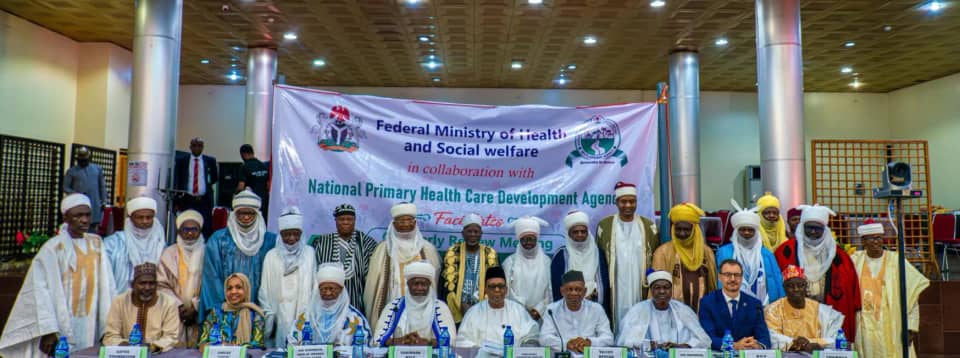
Traditional leaders across northern Nigeria have been urged to intensify community mobilisation and rebuild public trust in vaccination as the country steps up efforts to end poliovirus transmission and close persistent immunisation gaps.
The call was made at the second-quarter review meeting of the Northern Traditional Leaders Committee in Abuja, where traditional rulers, government officials and development partners stressed the critical role of trusted community voices in ensuring that no child is left unvaccinated.
The meeting brought together representatives of the Federal Ministry of Health and Social Welfare, National Primary Health Care Development Agency (NPHCDA), World Health Organization (WHO), UNICEF, Rotary International, the Gates Foundation and other partners.
The importance of community trust was illustrated by the experience of Amina Bindawa, a mother in northern Nigeria who initially hesitated to vaccinate her child after hearing conflicting information about vaccines.
She said she eventually accepted the vaccine after a community leader and health worker patiently explained its importance.
“I only agreed after they explained why the vaccine was important for my child. Now I encourage other mothers to listen and ask questions,” she said.
The experience, according to stakeholders, underscores the importance of traditional institutions in countering misinformation, mobilising families and helping health workers reach children who are routinely missed.
WHO Representative to Nigeria, Dr Pavel Ursu, said while health workers deliver vaccines and development partners provide support, traditional leaders play a unique role in creating the trust needed for vaccination programmes to succeed.
“Health workers deliver vaccines, partners can support vaccination, but traditional leaders significantly contribute to deliver trust,” Ursu said.
He added that traditional leaders help families understand why vaccination matters and why every child deserves protection.
Nigeria continues to face significant immunisation challenges despite progress in the fight against polio.
With an estimated eight million births annually, about 2.1 million children are yet to receive any routine vaccine. National routine immunisation coverage among children aged 12 to 23 months is estimated at 57 per cent, while coverage in northern Nigeria is considerably lower at 41.5 per cent.
Stakeholders said the figures represent a major equity challenge, with children in remote, insecure and underserved communities disproportionately affected by distance from health facilities, poverty, misinformation, conflict and inadequate outreach services.
Women and caregivers, particularly mothers, were identified as central to vaccination decisions, making sustained community engagement crucial to improving uptake.
Surveillance also remains a concern. According to the national polio statistics report for epidemiological week 30 of 2026, about 719 wards, representing 8.1 per cent of wards nationwide, were classified as “silent wards” — areas where suspected cases are not being detected or reported.
The development has heightened concerns over surveillance gaps that could allow poliovirus transmission to go undetected.
Chairman of the Northern Traditional Leaders Committee and Emir of Argungu, Alhaji Samaila Mera, charged traditional and political leaders to ensure that insecurity does not become a reason to abandon vulnerable communities.
“As traditional leaders, it is our responsibility to ensure that no child is left unimmunized, no outbreak goes unreported and no community is left behind,” Mera said.
He acknowledged that widespread insecurity remains a major obstacle to delivering essential health services to remote communities, but insisted that vulnerable populations must continue to receive attention.
“Traditional and political leaders must not use insecurity as an excuse to abandon vulnerable communities,” he said.
The Coordinating Minister of Health and Social Welfare, Dr Muhammad Ali Pate, also highlighted the planned US$615 million immunisation financing package for 2026 to 2030 as an opportunity to significantly strengthen vaccination services
The package comprises US$515 million from Gavi, the Vaccine Alliance, and US$100 million in counterpart funding from the Federal Government.
The funds are expected to support cold-chain infrastructure, vaccine delivery, frontline health workers and access to routine immunisation, while complementing broader reforms aimed at strengthening primary healthcare and domestic health financing.
The Executive Director and Chief Executive Officer of NPHCDA, Dr Muyi Aina, disclosed that Nigeria had reduced circulating variant poliovirus type 2 cases from 48 to 39 as of July 2026.
However, he said the detection of seven variant poliovirus type 3 cases required urgent intervention.
Aina said 70 per cent of detected poliovirus cases were concentrated in Sokoto, Kebbi and Zamfara states, where population immunity remains low.
In Sokoto, inactivated polio vaccine coverage was reported at just 10 per cent.
Analysis of 121 confirmed poliovirus cases showed that more than 80 per cent of affected children were zero-dose children, while 90 per cent had not received a routine dose of the inactivated polio vaccine.
The figures, stakeholders said, demonstrate the need to integrate polio campaigns with routine immunisation rather than treating them as separate interventions.
While campaigns can help interrupt active transmission, routine immunisation provides sustained protection and prevents children from becoming vulnerable to vaccine-preventable diseases.
Traditional leaders were consequently urged to mobilise families, identify missed and zero-dose children, support vaccination teams and tackle rumours through community, traditional and religious platforms.
The appeal is particularly important in communities where public trust in government health interventions remains weak or where insecurity and poor infrastructure make access to healthcare difficult.
WHO and its partners are continuing to support government-led efforts through disease surveillance, data analysis, training of frontline health workers, technical assistance, coordination and community engagement.
The interventions are aligned with Nigeria’s Health Sector Renewal Investment Programme, the national primary healthcare revitalisation strategy and the National Immunisation Agenda 2030, as well as the Global Polio Eradication Initiative.
Stakeholders said the objective is not merely to increase vaccination figures but to ensure that every child, regardless of location or circumstance, is reached and protected.
The Abuja meeting therefore ended with a renewed call for government, traditional institutions, health workers, caregivers, donors and development partners to translate funding and technical support into stronger immunisation services.
The message was unequivocal: every missed child must be found, every community must be heard and every dose must reach the child who needs it.